
You are using an out of date browser. It may not display this or other websites correctly.
You should upgrade or use an alternative browser.
You should upgrade or use an alternative browser.
What is the best jigsaw blade for the headstock?
- Thread starter Dpdarren
- Start date


Sonic Mountain
Well-known member
I use a fine cut, high speed curve cutting blade on mine. As others have said, best to cut roughly then refine by sanding.

FrankenWashie
Well-known member
I’m with the rest of the team here, fine blades coping saw or similar.
With some care, the results of the rough cut will be far easier to get into shape than using a jigsaw, see below:
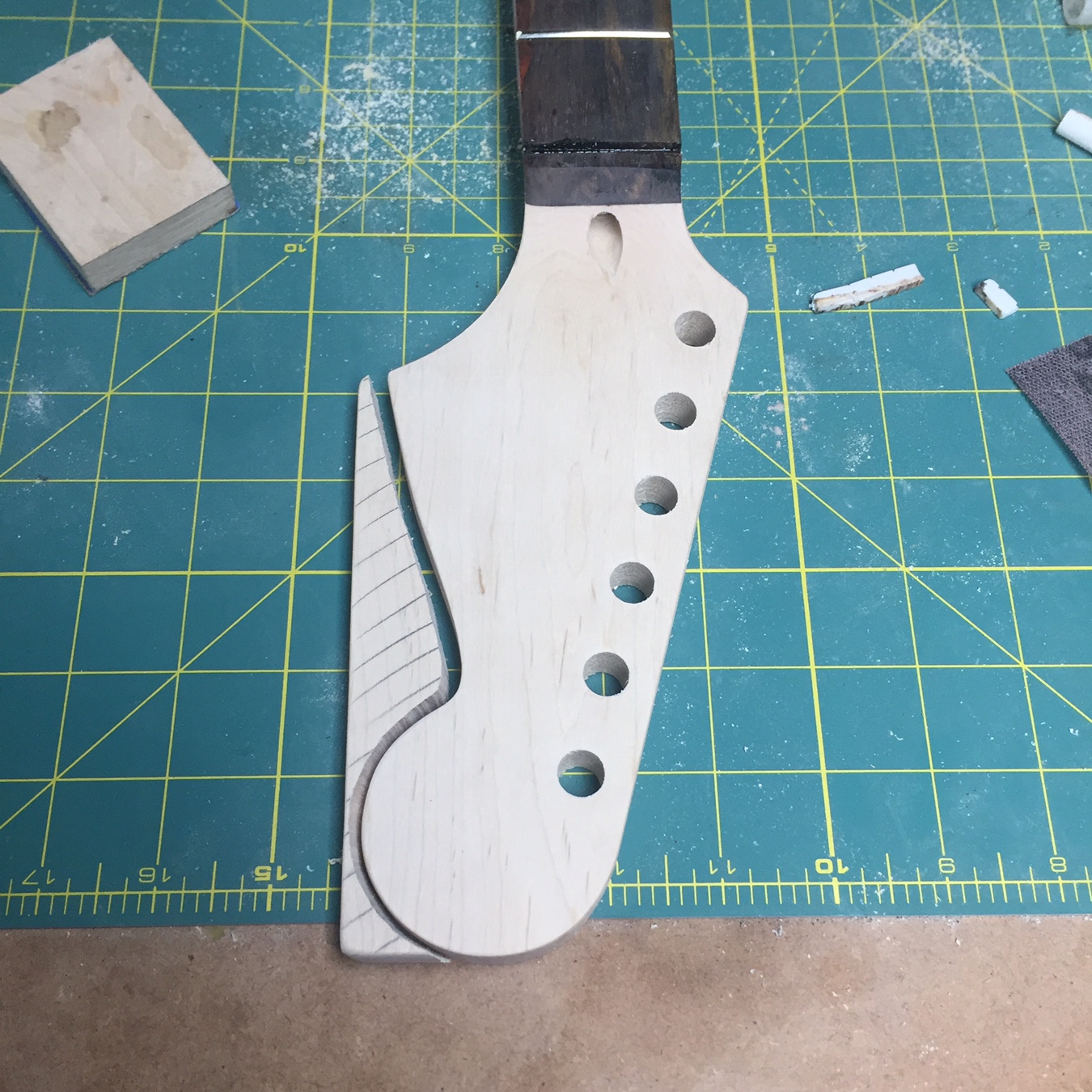
Sent from my iPad using Tapatalk
With some care, the results of the rough cut will be far easier to get into shape than using a jigsaw, see below:
Sent from my iPad using Tapatalk

king casey
Well-known member
Not in favour of using jig saws on head stocks.
Much prefer a small hand saw to follow beside the outline I've drawn for myself. Then use a file to bring it in nice and close, and then finish using sand paper. It's a slower process but the results speak for themselves...
I'll agree with that.
May be different with mahogany but maple proved too hard for my jigsaw.
I simply hand sawed the majority off with straight lines and then used a coarse rasp to finesse somewhat.
Files and sandpaper to smooth it down.
cheers, Mark.


Bakersdozen
Well-known member
Had a go with a coping saw tonight. It's much harder than it looks. I get you have to turn it while in motion, but sometimes it just doesn't want to go where you want it to. Any tips on execution? How do you manage to go slow and steady and still manage to get it to curve?
FrankenWashie
Well-known member
I found that in order to control the turn, you’ve got to ease the forward pressure on the blade and rotate the saw so that it digs in with the teeth on The side you are turning to. This starts the cut drifting along the curve you are after.
this is easier to do with the finer depth blades, some I have seen with big box store saws are 6mm or so. I use some eclipses blades that are around 3mm (front to back) and these hold their edge better and (I have found)are far easier to control.
above all take it slow, brush or blow away the sawdust to keep your line in sight and keep the blade square to the work and straight up and down in the cut.
Bakersdozen
Well-known member
Thanks mate, for the sage advice. Will keep practicing.I found that in order to control the turn, you’ve got to ease the forward pressure on the blade and rotate the saw so that it digs in with the teeth on The side you are turning to. This starts the cut drifting along the curve you are after.
this is easier to do with the finer depth blades, some I have seen with big box store saws are 6mm or so. I use some eclipses blades that are around 3mm (front to back) and these hold their edge better and (I have found)are far easier to control.
above all take it slow, brush or blow away the sawdust to keep your line in sight and keep the blade square to the work and straight up and down in the cut.

Marcel
Well-known member
There is a hacksaw blade that is round and will cut in any direction that you apply pressure to. It cost about $13 and is 2mm thick so it will cut out a lot of material and the going will be slow. I have used in the past on my SGM-1 build head stock and a long forgotten LP build and on both the job was done on the Mahogany in close to an hour. Quite useful for odd shape first cuts though you need to keep an eye out for tear outs on the back of the job as it is a quite coarse blade.

PJSprog
Member
I’m with the rest of the team here, fine blades coping saw or similar.
With some care, the results of the rough cut will be far easier to get into shape than using a jigsaw, see below:
Sent from my iPad using Tapatalk
Rotary cutting mat, eh Washie? (my Wife is a quilter)
FrankenWashie
Well-known member
Yeah, mine makes kids and ladies clothes as a side business. I inherited a number of her smaller mats for the lab as I bought her an A0 sized one for her cutting table.Rotary cutting mat, eh Washie? (my Wife is a quilter)

Fretworn
Well-known member
Had a go with a coping saw tonight. It's much harder than it looks. I get you have to turn it while in motion, but sometimes it just doesn't want to go where you want it to. Any tips on execution? How do you manage to go slow and steady and still manage to get it to curve?
New, sharp blades. Anytime I’ve had an issue it was because I need to replace the blade.


