Peavey 410 TX 4X10 Inch Bass Cab

DrNomis_44

Well-known member
Hey Everyone,


I'm in the process of buying a second-hand Peavey 410 TX 4X10 Inch Bass Cab from a friend of mine, I'm buying it for use as part of a bass rig with my Fender Super Twin amp, I've done some testing and as far as I know it just needs a complete set of replacement speakers to get it working again, it could also do with a good clean-out while I'm at it, should be a good project for next year.

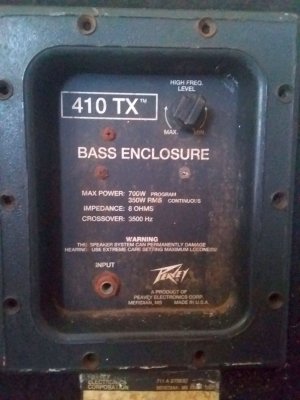
The bass cab is rated for a maximum of 700 Watts into 8 ohms, so if I wire-up the new speakers in a series/parallel configuration, each speaker needs to be able to handle 1/4 of 700 Watts, or at least 175 Watts by my calculations.

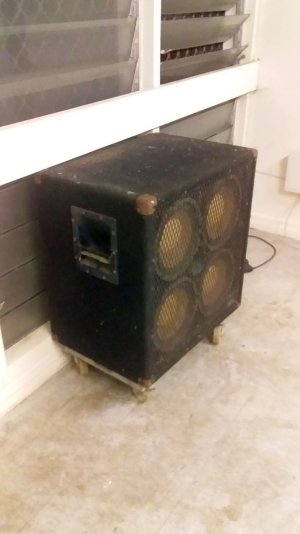
Here's a couple of pics of the bass cab:
 

Attachments

  • Peavey Bass Cab 1_resized.jpg
    Peavey Bass Cab 1_resized.jpg
    180.9 KB · Views: 208
  • Peavey Bass Cab 2_resized.jpg
    Peavey Bass Cab 2_resized.jpg
    103.9 KB · Views: 204
Sounds like a great project! Have you got any plans for what speakers you will put in?
 
Sounds like a great project! Have you got any plans for what speakers you will put in?

Not currently, but I'm going to see if I can find replacements that are close-enough to the originals, what would you suggest?

There's a chance that I might be able to salvage the originals and get them working again if the voice-coils haven't all been burnt-out, I checked with my multimeter and got a reading of about 32M Ohms, which is clearly an open-circuit in my book, it should read roughly about 8 Ohms or so.

I'm guessing that it is actually a bass cab for a P.A. system, it has a 3500Hz crossover circuit board in it, but, I can't see why it couldn't be re-purposed for use as part of a bass rig.
 
Last edited:
Not currently, but I'm going to see if I can find replacements that are close-enough to the originals, what would you suggest?

I have no clue when it comes to bass speakers. I spent ages reading up on 12" guitar speakers, but in the end it felt like it was all so subjective the reviews didn't amount to much anyway
 
The wooden box itself has no rating, so you can fit whatever rated speaker you want and the cab rating will be 4 x whatever the speaker rating is. This will give you a lot more flexibility in driver choice. I’d suggest each driver be rated at least at 100W, for a minimum 400W cab rating, as your amp will produce well over 200W if driven hard, probably nearer 350W if distorting. The ear is less sensitive to bass frequencies than mids, so you need more watts to drive the speakers to get the same apparent volume. So you’ll probably find that you have to turn up the amp a lot more than you normally would.

The driver impedance is also your choice. Peavey chose 8 ohms because it was designed to work with their transistor bass amps, and an 8 ohm 4x10” cab and an 8 ohm 1x15” cab would provide a 4 ohm load for the bass amp, giving maximum power output for the amp (compared to an 8 ohm or 16 ohm load). Used with a valve amp, the impedance rating doesn’t really matter as long as there’s a tap for it on the amp’s output transformer.

95% of bass amps are solid state, so almost all bass cabs will be 8 ohm rated to give 4 ohms when paired with another cab. So 8 ohms would be a good choice if you plan to add another standard bass cab and you don’t plan to swap out the speaker. But 16 ohms is a slightly better choice for a valve amp speaker, as you could then pair it with say a 16 ohm Marshall 4x12” cab.

Driver frequency response needs to be considered as 10” speakers can be very mid-biased. Your amp has passive tone controls, unlike a solid state bass amp which will have active tone controls, so whilst you can cut mids and treble, you can’t boost the bass to make up for a lack of response if the driver’s frequency response isn’t great at bass frequencies. So compare the frequency graphs and think about the response around the 40-80Hz region, where the bass fundamentals will be and compare them to the mid response levels. The bigger the difference, the more mid-forward and boxy it will sound.

It’s not a PA cab, it’s definitely a bass amp cab. The crossover is there for the centrally mounted HF tweeter. That may be a piezo unit, a compression driver or even a small diameter standard driver. There's often an on/off switch for that or maybe a level control. Something you’d want out of circuit if you ever used the cab for guitar used with distortion, and you’d then want the crossover out of the signal path completely.

If you want to have it a dual purpose bass/guitar cab you’d be better off removing the crossover and disconnecting the HF driver, (maybe remove that too and blank off the hole). Unless you are playing a lot of slap bass or a lot of high notes, then you won’t notice the loss. It’s not something you need for rock/blues bass as long as there’s no crossover dropping off the high-end. 10” speakers have a reasonable HF response, certainly compared to 15” or 12” speakers.

The cab doesn't appear to be ported at the front, so unless there’s a rear port, there’s no need to consider the TS parameters fir tuning and getting a speaker that closely matches the originals. If there is, then you’ll probably want to get the same drivers if possible, though that may prove to be expensive.

Do you know the cab model ref, as the literature may give a frequency response, which will indicate how good an all-round cab it is, or whether it really was mid-biased and should be used with a 1x15” to fill out the bottom end.


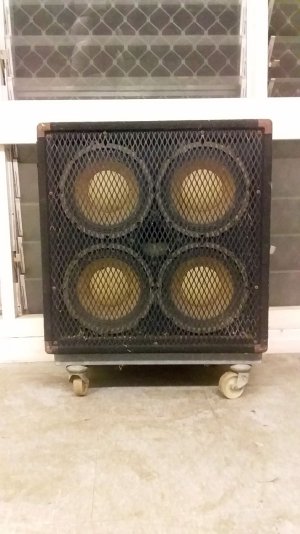
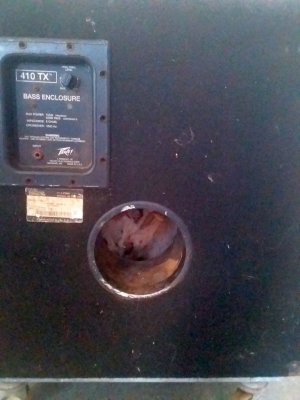
As it just so happens, the Peavey 410 TX bass cab does indeed have a bass port on the back of it, I'm not sure what it's model ref is, I'll have to leave it till the morning to find out, will post it here if/when I do.
 
It's worth reiterating that when it comes to bass rigs it doesn't matter how good the drivers are if they are in the wrong cab. Worse still if the cab is wrong enough you can blast the cones across the room with just a fraction of the rated power.

Basically you have two choices. One is to get a set of original drivers, and the second is to modify the cab to suit the new drivers. This isn't quite as big a deal as it might be since the total volume is hopefully going to be reasonable, so it's just a question of altering the porting.

One other thought though, in these days a 4x10 is usually overkill, and they are also horribly directional. You might want to consider whether this cab would be better broken up for the fittings - could be pushing a coupla hundred dollars new with the grill - and build yourself a custom 2 x 10 cabinet, maybe using one of eminence' own published designs, which would be cheaper with just two drivers, less bulky and generally a better job all round. A left field compromise would be 3 x 10 mounted vertically which has much less directionality than 4 in a square. 3 16 ohm drivers is near enough 4 ohms impedance, it being a very approximate measurement.
 
Thanks Doc for answering a question that has dogged me for the past few years.

I bought a 4x10 cab off a needy bass player a few years back for little more than what one 10" driver would cost, and my unmarked cab looks identical to yours so now I know it is a Peavey cab. At the time of purchase he said it was a 400W cab and it was clearly visible from the front that it was loaded with Eminence drivers so I had little hesitation in buying it. Later I discovered the drivers are Eminence Legends.

I use a TCE BH-250 head with it and after replacing the damaged plug on the back to a speakon it has performed flawlessly. I attached a set of dolly wheels to aid maneuverability and put a 4" fan grill over the port on the back to lower the risk of items dropping inside the cab (as is the habit of walking toddlers). The BH-250 is plenty for my purposes, with my main thing being I just want to be able to hear my bass builds at a somewhat reasonable volume

It is not the loudest cab around. It is more than enough for a band rehearsal and practice, probably loud enough for a small bar or club, but it would be stretched in a beer garden or large room. Those Eminence drivers are the bomb, Nice clean strong bottom end with plenty of top end clarity so rock/punk/metal or slap bass is nil drama.

Never have tried the rig with a regular guitar, yet I suspect it would work reasonably well in a pinch.
 
A bit later on today, I'm going to remove the front speaker grill from the Peavey 410TX bass cab so I can remove one of the speakers so I can have a good look at it, while I'm at it, I'll grab my tape measure and measure the outside dimensions of the cab itself, will also post some pics of the back panel as well.


@ Marcel No worries at all mate.


I should add that I'm mainly interested in using the bass cab for bass guitar amplification purposes, I compared the circuit diagram for my Fender Super Twin amp with the one for the Fender Super Bass amp, and to all intents and purposes they are practically the same with some very minor component differences, and from my experience the Super Twin seems to work fine if used as a bass amp, interestingly, when Fender released the original 4 X 10 Tweed Bassman, it was originally intended as a bass guitar amplifier, guitarists soon learnt that it also worked great as a guitar amp, and was used as a design reference by Marshall for the design of their first Marshall JTM45 amplifiers back in 1962 or so.


I just found this interesting forum thread:

https://www.talkbass.com/threads/peavey-410-tx-speaker-repair-or-replace.951832/


Okay, here we go, the outside dimensions of the Peavey 410TX bass cab are as follows:

Width = 615mm.

Depth = 435mm.

Height = 625mm.

All the speakers are indeed 10 inch in diameter, the cab itself seems to be made out of 20mm particle board, or, it could be 20mm plywood, hard to tell.


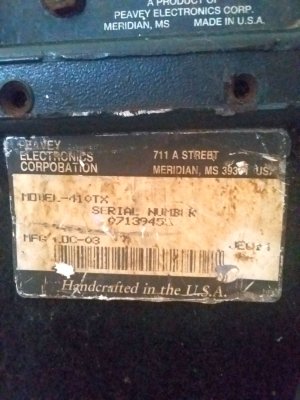
Some more pics of the cab:
 

Attachments

  • Peavey Bass Cab 3_resized.jpg
    Peavey Bass Cab 3_resized.jpg
    209.8 KB · Views: 202
  • Peavey Bass Cab 4_resized.jpg
    Peavey Bass Cab 4_resized.jpg
    247.4 KB · Views: 197
  • Peavey Bass Cab 5_resized.jpg
    Peavey Bass Cab 5_resized.jpg
    213.1 KB · Views: 186
Last edited:
Update:


I just managed to remove all of the speakers from the enclosure, about two of the mounting-screws seized-up and broke while I was removing them, that's ok cause the speakers are going to be replaced anyway, turns out only one of the original speakers is still good, the voice coil measures about 6.5 Ohms or so on my digital multimeter, but that could be erroneous so I'm not going to take it as gospel.

The insides of the cab could do with a decent clean-out, which I might do later on this year.


I gave the insides of the cab a bit of a spray with some air-freshener cause it doesn't half have a bit of a pong to it, it's all sorted now though.


Ok, so why were the other three speakers not working?, pretty simple really, the short pieces of flexible wire connecting the voice-coils to the terminals were broken, and even non-existent in a couple of the speakers, rather than try and repair them, I'm just going to cut-to-the-chase and replace the lot, all the original acoustic dampening material needs replacing too....did I mention that the cab needs a decent vacuuming-out and clean as well?


I've pretty much done all I can with it for the time-being, so I'm going to leave it alone till I can get replacement speakers and new acoustic dampening material for it, and etc.
 
Last edited:
Note that it was rated at 350 ohms RMS. That 700W is 'program', so the original speakers are likely to be rated at around 80W RMS each (maybe 75W with an allowance for the HF speaker). 'Program' (or 'music') power is a rating deigned to give a maximum suitable amp output value to match with the cab. RMS is obviously based on a continuous, fixed amplitude, sine wave, and as bass (and guitar) signals aren't continuous or fixed amplitude, but dynamic and with gaps between, then you can get away with using a bigger amplifier, normally rated at up to twice the speaker RMS value, as the overall power level handles by the speakers will be roughly the same when used with an instrument like a guitar or bass (less so with synths that can give constant amplitude outputs). The wattage rating of a speaker is a measure of how much maximum average energy the voice coils can handle (normally tested for 1 hour these days) before they run into thermal problems and voice coil insulation starts melting.

The 2:1 power amp:speaker rating really works best for solid state power amps, where the rating (normally measured at around 5% THD) is very close to the maximum power the amp will output, even with serious amounts of distortion. With a valve amp, where the rating is still made at a clean level, there is still often a lot of extra power available once the power amp is overdriven, maybe an extra 80% or more, so you are best limiting a valve amp to the speaker RMS rating. So anything above 200W RMS should be fine.

If you can compare the internal dimensions and port size with Marcel's cab and they are the same or very close, then those Legends sound like they would be a good choice as we know they work in Marcel's cab.


Just had a look at the datasheet pdf I downloaded for those Eminence Legend speakers, and I think I will get a set of four of them for my Peavey 410TX bass cab next year when I can afford it.

Apparently there's a mod you can do to the crossover circuit board to make the cab sound less mid-scooped, which basically involves bypassing the inductor in the crossover, I'll have to look into it, bypassing the inductor makes the frequency response more wide range.

https://www.talkbass.com/threads/by-request-how-to-bypass-the-peavey-410tx-crossover.78034/
 
Last edited:
I'd leave it as it is until you get the new drivers in. You don't know how it will sound with both different drivers and your amp. Wait, see how it sounds and then make a choice. At least it's something you can probably test out with a crocodile clip link, so it doesn't need to be permanent (or even add a switch to select it in or out).

Does the mod shift the crossover frequency upwards or downwards? You need to be careful with shifting it downwards too far, as that passes a lot more energy to the HF driver. No idea what it's rated at but they normally aren't that highly rated. They don't need to be with a 3.5kHz crossover, but the lower the crossover frequency, the more energy they have to cope with.
 
Apparently there's a mod you can do to the crossover circuit board to make the cab sound less mid-scooped, which basically involves bypassing the inductor in the crossover, I'll have to look into it, bypassing the inductor makes the frequency response more wide range.
I'm fairly surprised at the described process not including tracing the circuit first. It's not generally that hard with a crossover.

If its a simple one inductor one capacitor crossover then bypassing the inductor turns the crossover into a high pass filter protecting the tweeter. Removing the tweeter as well turns the exercise into a very complicated way of wiring the woofer direct to the input socket.

It's not unusual to wire bass cabs, even some of the very best ones, with a high pass filter rather than a crossover to protect the tweeter. On a typical bass guitar driver the frequency response falls and the impedance rises strongly with frequency, so the results can be wholly satisfactory. It would be a different story with a mid driver in the mix.

Jim C
 
Those are good points you bring-up, maybe I could add a switch that bypasses or switches-in the inductor, but as Simon Barden says, maybe the best thing to do is to wait till the new speakers are installed and see how it sounds with the crossover operating normally.

@ Simon Barden I'm probably going to have to trace-out the circuit for the crossover to figure-out exactly what it's doing to the overall frequency response.
 
Last edited:
I see that the guy who did the mod had already removed the tweeter (which seems to be universally considered as a bad unit) so you are really letting the drivers work as full range units and providing more treble. 800Hz is the common centre EQ frequency used by most bass amp with a single mid control, so 3.5kHz and above is really letting the low/mid treble back through that the HF driver won’t be providing. That Eminence driver looks to be giving useful output up to about 5kHz, after which it drops down quite quickly, so removing the crossover and the HF driver will make that treble available from the 10” drivers.

The bass and mid controls on guitar amps are normally up an octave from those on bass amps, plus your amp’s are just subtractive, so you may find a bass graphic EQ pedal (or a wider range pedal with more bands than say a Boss guitar graphic pedal has), useful in sculpting your bass sound.
 
On the one hand tweeters on bass rigs are highly polarising, and loved or loathed on TB, so I'd be wary of making judgments on that rig based on the comments. On the other hand though I was looking to see if I could find a circuit diagram for the crossover, and I found that Peavey issued two revised models of that cab, and the pr for both put crossover and tweeter changes first.

Were I doing this I would build the cab without tweeter or crossover and concentrate on tuning the ports and bass response. Only when happy there would I see if I felt an HF unit were needed.
 
Okay, here we go, the outside dimensions of the Peavey 410TX bass cab are as follows:

Width = 615mm.

Depth = 435mm.

Height = 625mm.

All the speakers are indeed 10 inch in diameter, the cab itself seems to be made out of 20mm particle board, or, it could be 20mm plywood, hard to tell.

Hmmm, Seems my cab is a bit smaller, but not by much.

Mine is roughly 62cm x 62cm x 39cm. And nil fancy connector plate, just a simple molded metal plate large enough for two connectors and held in with 6 screws . Also my cab is covered with black marine carpet all over the top sides and back hence the measurement inaccuracy. Front is just painted black with the grill.

I doubt the minor size difference in the cabs would affect how it sounds with diff drivers too much. If it were me I'd be disconnecting that control and getting a nice new set of Eminence Legend drivers for your cab.
 
Roughly 12% more internal volume than Marcel's then, which is not insignificant when looking at bass cab tuning. And the port size could be different. So I'd be a bit wary.

I'd enter the TS parameters for the Eminence into a cab calculator, and add the cab internal volume and port details into it and see what the results look like, and compare that to an ideal cab selection for the speakers.
 
Back
Top