Glueing neck onto body of RCA-4 Bass

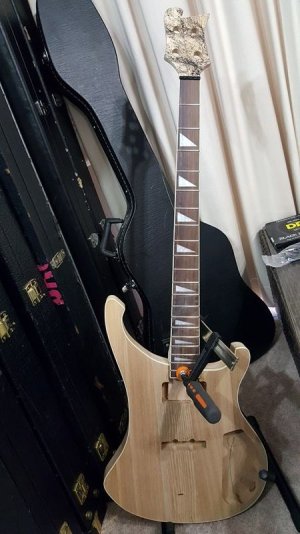
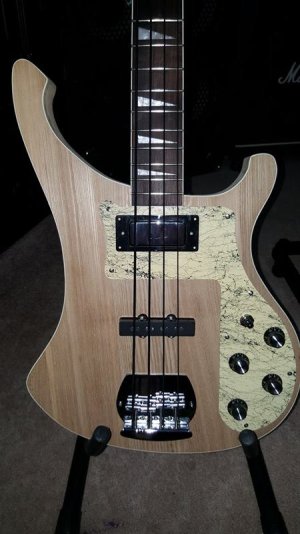
i just glued the neck to the RCA-4 bass and i am a bit concerned it might be crooked. It does not seem in line with the pick ups. I did try and straighten it but couldnt...it only fitted in one position. I watched google videos and they all say "to push neck in as far as it will go". It will not move as the neck where it fits into the body is tapered. I will continue to build i and see how i go. I did hold the bridge to the body in line with the pick ups, but it is not in line with the nut on the neck. I may have to have the bridge on a bit of an angle to compensate.

I would add pictures, but this is not letting me ... Just saying no files chosen after about 2 minutes of waiting for the pic to load !
 
If the glue hasn't dried yet, pull it out.
Did you test it for being in line by running the top and bottom strings in place and seeing if they run square on the neck?

Your pics might be too big, there is a 1000pixel limit on the longest side.

Rule One of Doing Almost Anything: "if you aren't sure.....don't."
 
Last edited:
Wise words Dedman.

Hmmm, as I am 2 and a half hours late on the scene just hope you have been able to pull the neck out before it cures??? If it is being difficult somewhere in other forum threads I have read that using a steam iron can help loosen things up, might need to put a damp rag between iron and guitar to prevent scorching. Just hope you were using Titebond and not some other super strength stuff as it will let go with applying steam.
 
14874905_10154455067116690_776356763_n.jpg

I managed to make the pic smaller. Here it is attached. The neck is solidified to the body as it has been nearly 24 hours. The neck would not move in the cavity of the body, I tried straightening it, but couldnt, only stayed in that one position before gluing it. I thought that is how it is supposed to be. Maybe the routing of the neck cavity in the body is crooked?
 
Get some string/wire/bass strings whatever and check. Tie two lengths to the e and g string tuner holes, run it through the nut, position the bridge roughly where it's supposed to go and tie them on that, stick the J pickup into it's cavity and move the bridge around until the strings (or whatever) are aligned in between the pickup slugs. This will tell you very quickly if your neck is straight.
 
I loaded the image into photoshop and drew some lines along the two edges of the fretboard to see where they ended up in comparison to the bridge pickup. There may be a slight bias towards the bass side, but if there is, it's not huge. You shouldn't have a problem with the neck pickup and the bridge can be located to match the neck angle. So it's just the bridge pickup that might be slightly out.

If necessary, you should be able to enlarge the cut-out slightly so that you can locate the pickup so the pole pieces are directly under the strings. If you are fitting the silver pickup cover over the strings, then you won't notice it at all. If not, then you may need to be a bit neater with any enlargement so that it looks symmetrical, but it should be relatively easy to do with a small drum sander on a Dremel for the round fixing lug areas, and a small chisel for the square end of the cavity.

Do not lose hope!
 
all fixable, and if worse comes to worse, if you used Titebond, you can steam it off to release the glue and fix it and go again
 
Thank you so much Stan, Simon, Pablo, Waz and Deadman, for all your help and advice...Especially Simon for going to all that trouble for me, much appreciated Mate. I will stick with it and see how i go. Can anyone please tell me what is the difference in volume and tone pots with A250k, A500k, B250k and B500k and so on please ? And what does the capacitors between pots do please ?
 
The pots with an A in front have an 'audio' (or logarithmic) taper, those with B in front have a 'linear' taper. Audio pots allow the volume to be controlled so it gradually increases or decrease in volume. Using linear pots for the volume control results in a very sudden initial drop in volume for a very small rotation of the pot. So certainly use 'A' type pots for volume controls.

People use both A and B type pots for tone - with an audio pot you sometimes have to turn it down a long way before you get a noticeable tone change, which is fine if you like subtle changes in the amount of treble produced but if you want to knock off some of the brightness quickly, then use a B/linear pot.

The numbers represent the pot's resistance in kilo-ohms, so 250k is 250k ohms, 500k is 500k ohms. A 500k pot has twice the resistance of a 250k pot. Because one end of the volume pot 'track' is usually connected to earth, the other end of the 'track' to the signal from the pickup, and the wiper (the arm that the knob sweeps around the pot's resistance 'track') is connected to the guitar's output, then there is a small but significant path for some of the pickup signal to pass through the pot's track to earth. Because the pickup has both inductance and some capacitance, the pickup inductance coupled with this resistance path forms a filter circuit which knocks some of the treble off the pickup's output. The greater the resistance, the less treble is lost.

Typically single coil pickups (with a brighter sound than humbuckers) use 250k pots and humbuckers use 500k pots (to loose less treble). You can use 500k pots with single coils, but they often sound too bright as a result. If you mix humbuckers and single coils on a guitar with a single volume control, then you have to compromise, typically running with 500k, which either means the single coil is a bit bright, or a duller sounding single coil has to be selected. Some people use 1meg ohm pots (1000k ohms) with very powerful humbucker pickups that can otherwise sound a bit dull. But you can't take away what isn't there, so while increasing the pot value even further will move the cut-off point up the frequency range, once you are above the highest level of audible frequencies produced by the pickup, there is no further effect on the tone.

The capacitor taking some of the pickup signal from a connection to the volume pot to the tone pot, forms a simple low-pass filter circuit, which is tuned by turning the tone pot knob to adjust the tone pot's resistance. The lower the resistance, the lower the cut-off point of the low-pass circuit and the duller the pickup's output gets.

There are a couple of ways volume and tone circuits can be wired up - the above is only one of them - but the basic principles stay the same.
 
Thank you Simon for all that info, very helpful indeed. I am considering changing the passive pick ups to actives. Is that hard to do, with re wiring the passive configuration considering i have to add a 9 volt battery ?
 
It's not that hard to do, providing you are reasonably OK at soldering. There are two types of active guitar. One has standard high-impedance pickups that feed into an active tone control (plus often some form of boost) circuit. The other style (e.g. EMG) uses low-impedance pickups with a small signal amplifier built in to them, which again feeds into an active tone control circuit.

It's normal to buy either the tone circuit (with standard pickups) or the low-impedance pickups plus tone circuits, complete with matching pots (many circuits are often built on to the end of the pots, rather than on a separate board). The active electronics gives a high-impedance output that generally requires lower value pots (EMG are normally 25k). The active high-impedance output negates nearly all of the pickup 'loading' that signal cables and amplifier input impedances put on a passive guitar, so you can use long cables running across stage (with muck associated leaping about and knee sliding) without them affecting the guitar's tone.

Note that when using high-impedance pickups with an active circuit, it doesn't automatically mean that the pickups will be quiet. High impedance single-coils will still pick up interference and mains buzz as before. I once had an active Yamaha BB604 bass, with very noisy jazz-bass style pups in. Swapped them over to humbucking Bartolinis and it turned it into a very quiet and nice sounding bass.

Low-impedance pickups by nature pick up very little interference and so are inherently quiet.
 
Hi guys, I've had to edit this thread.

Although it's legal to put brand name logos on a kit you have built for your own personal use, we are not comfortable with you posting those images on the Forum.

Please just blur or delete any brand name logos you've put on your build before posting.

Any questions, just email me.
 
Thank you Stan. I will enter the pictures. How do i do that please...enter all the kits i have built ?

Adam, i do apologize, i did not know that. Next time, I will take the photo before i put a logo on the headstock.
 
Go to the current GOTM thread , in this case December , read the rules in the first post and upload the appropriate pics as you do in a build thread.
I highly recommend doing your own logo , even if in the style of the company responsible for the style of the guitar you have built. You made it, they didn't , be proud of your work
 
Back
Top