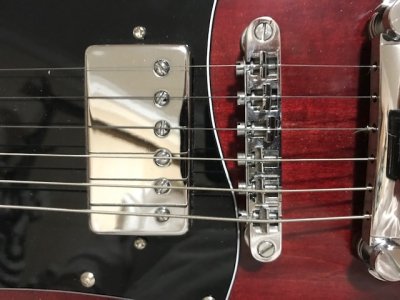
12th fret to Bridge/Saddles is longer than 12th Fret to Nut - WTF?

Gavin1393

Moderator
Quote from Gavin1393 on April 21, 2013, 18:51

This might not be an issue and in fact is probably one of the most frequently asked questions . it's great that you have done a mock build before getting going as this will always point to where problems are or where issues will be covered by a pickguard so aren't that important. Often we will pick up a comment on the forum where someone is about to hack away at the neck, body, pickup routings, pickguard etc. because they assume the distance from the 12th fret to the nut and to the bridge should be exactly the same. This isn't the case as one might expect because you need to compensate for the strings. For this reason you will see an angled saddle on an acoustic guitar. The thicker the strings, the greater the distance from the 12th fret the saddle will be if intonation is set correctly. Being an acoustic builder you get one chance at getting the bridge in the right spot. Get it wring then you have to go through the process of removing strings, breaking the glue's grip on the bridge and soundboards and starting again. This is probably why i am so meticulous with this when building an acoustic. Probably also why i dont stress much with building electrics since the bridge only needs to be there-abouts and you can still get great intonation. So before you rush out and start thiñking about modifications you actually dont need to make can you please take some measurements and post the results of those measurements on this thread? I need these measurements in order to help you.

The first measurement I need is for you to measure from the FRET-WIRE of the 12th FRET,to the point where, if you ran your finger along the strings, you would touch the nut. Hence you are measuring the nut from the 'bridge side of the nut rather than from the 'Headstock' side of the nut.

The second measurement I need is from the same point on the 12th FRET,that is, measure from the FRET-WIRE of the 12th FRET. I first want you to use a screw drive and wind the saddles on the bridge as far forward (towards the pickups) as they will go. When you have done this please measure the distance from the saddles to the 12th Fret.

Secondly, I would like you to wind the saddles away from the pickups as far back as they will go. Please re-measure the distance from the saddles to the 12th Fret.

Please provide me with those measurements exactly as they are and I will then try and assist you.
w6c00-Nut-to-12th-Fret.jpg
[/quote]
 
I haven't yet got to the gluing of the neck as the weather has slowed progress on the finishing of the guitar and neck. Whilst continuing to ruminate over this one I decided to go to the video again. In the glued in neck video Adam mentions that its important to get the distance from the nut to the 12th exactly the same as the distance from the saddle to 12th (and adds there is some wriggle room but ensure you are as near as to the front edge). Hence my concern and the query. Possibly why there are others also worry about this.

I know Adam is updating the videos. It might be worth considering how best to describe this for nuffies like me who take things literally. I assume there are some tolerances that could be provided as a guide.

Cheers
Glenn
 
Hi Glenn

If you follow my article above you wont go wrong. i think Adam may update the video to contain this information. It is important to know that the video's were made prior to Luthiers like DingoBass and myself coming onboard. This is the reason for the forum too, to hopefully provide the latest information n techniques, solving problems and finishing the guitar. I dont think we would have all discovered Wudtone if it wasnt for the forum.

Your point about the video creating confusion and doubt is correct so look out for video version 2!

Gav
 
Gav, maybe you should star in the intonation / setup video, and use the techniques that you posted in that massive thread!!!
 
12th fret to bridge etc...

Hi Gavin,

I have an ES-1GT kit and the mock assembly gives me the following measurements:
- Bridge side of the nut to the crown of the 12th fret: 313mm
- Crown of the 12th fret to the bottom E string saddle wound all the way forward/wound all the way back: 320mm/326mm
- Crown of 12th fret to the top E string saddle wound all the way forward/wound all the way back: 317mm/323mm

These measurements are with the neck as far into the neck slot as it will go and that actually means that the neck pick-up does not quite fit and I will need to shave a couple of mm's out of the side of the pick-up hole so that the pick-up sits nicely.

Is this something to worry about?

Thanks for any advice.

Tom
 
I am having a problem setting the intonation on a 5 string fretless bass kit.
nut to 12 pos. marker is 418mm if I then set the b string adjuster at 418mm the earth wire hole is exposed by 12mm.
saddle to 12 pos. mark all the way forward is 415mm.
saddle to 12 pos. mark all the way back is 435mm.
I hope that this is the information you require, any help would be greatly appreciated.

yours laurieb.
 
Hi Laurie, welcome to the forum, is this a 5 string jazz bass fretless kit ?
You need to measure to the centre of the 12th fret wire, not the dot marker, if you have measured to the marker then please post distances to centre of 12th fret wire.
Usually there needs to be compensation for string widths so distances 12th fret to saddle will be more than nut to 12th fret.
 
With a 34" scale the nut to crown of 12th fret should measure 17" and from there another 17" to middle of saddle for G String.

As each string gets thicker the saddles have to be moved back to lengthen the string.....this is called compensation.

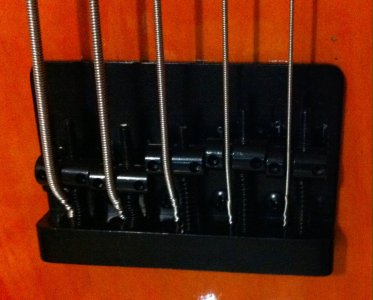
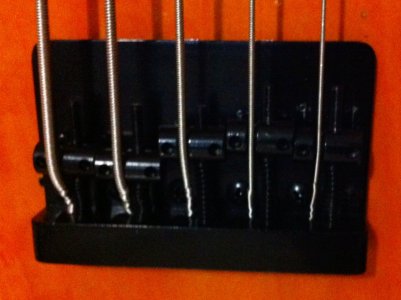
I have just taken a couple of shots of my EX-5 bridge where Low B saddle is about 5mm further away from the nut when compared to G string. Being such a low frequency these things are hard to tune and intonate if using an electronic tuner and you may need to tweak things a bit through tuning by ear.
photo 1(20).jpgphoto 2(19).jpg
 
good advice Waz. I suppose first thing we need to establish is what kit Laurie us building and where he has taken his measurements from. I guess it could be different scales between a F, G type and Ibanez scale. My guess being fretless is it's a new jazzy 5 string so whatever a F type bass scale it is.
 
Spot on Woks. Most Bass scales are typically 34" for Long Scale or 30" for short such as on Hoffner & SG shapes but if in doubt the double nut to 12th fret crown measurement works every time.
 
Hi Laurie, welcome to the forum, is this a 5 string jazz bass fretless kit ?
You need to measure to the centre of the 12th fret wire, not the dot marker, if you have measured to the marker then please post distances to centre of 12th fret wire.
Usually there needs to be compensation for string widths so distances 12th fret to saddle will be more than nut to 12th fret.

I checked my original measurements against my fender fretless and came up with the correct distance !!
bridge now installed and looks good.
just brain fade and a bit of panic.
thanks for making me think <better if avoided I get into less trouble!!>

thanks laurieb.
 
Sorry for asking a very basic question. I am a first time builder looking for more clarity.

What position should be the saddle in Tom bridge when taking measurement from Nut or from 12th fret.

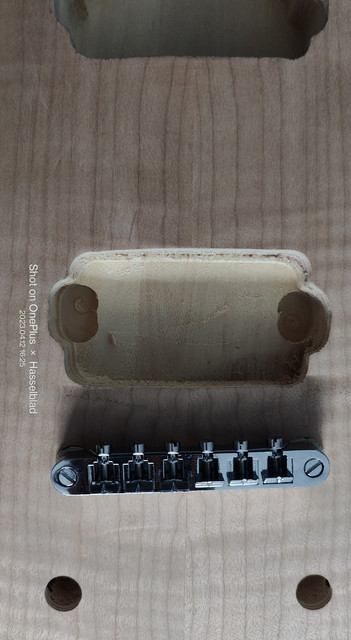
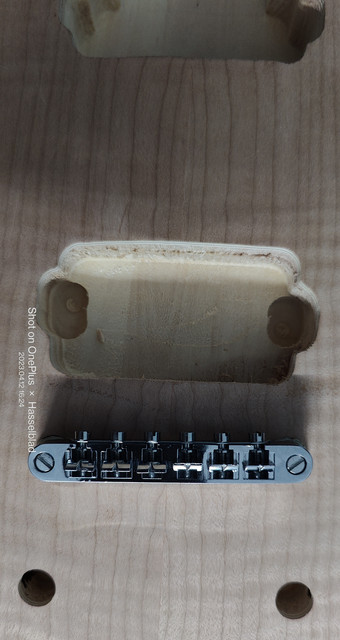
Should it be as close to the bridge pickup like this?


Or toward the tail piece like this?


Or in middle so that if the intonation goes flat or sharp there can be some compensation on both ways?


I thought middle is fine. But all the videos I see says it should be at top near the bridge pickup. If it is that way, then if the fretted note is flat then how can that be compensated? Or is it usually sharp even at the top point so that all it requires is moving the saddle towards the tailpiece always?

May i know What is the science behind the position


Sent from my NE2211 using Tapatalk
 
Last edited:
The guitar scale length is measured from the fretboard side of the nut to the saddle for the high E string. For the TOM (or any!) bridge the saddles are in a step wise arrangement (see the picture below). The TOM bridge is not parallel to the PUPs to account for the lack of travel (or adjustment) of the saddles.

The actual position of the saddles will depend upon the type of strings used, thickness of the strings used, the height (or action) of the strings from the neck. All these factors will determine the final string length for intonation.

The Science behind it is that when a string is pressed onto a fret (say 12 th), its tension must increase, which increases the frequency of the vibrating string. To compensate for this the string need to be made slightly longer than the scale length. The thicker the string, the greater the change in tension, so the longer the intonation length.

I hope this helps!
 

Attachments

  • IMG_1621.jpg
    IMG_1621.jpg
    81.1 KB · Views: 1,301
The guitar scale length is measured from the fretboard side of the nut to the saddle for the high E string. For the TOM (or any!) bridge the saddles are in a step wise arrangement (see the picture below). The TOM bridge is not parallel to the PUPs to account for the lack of travel (or adjustment) of the saddles.

The actual position of the saddles will depend upon the type of strings used, thickness of the strings used, the height (or action) of the strings from the neck. All these factors will determine the final string length for intonation.

The Science behind it is that when a string is pressed onto a fret (say 12 th), its tension must increase, which increases the frequency of the vibrating string. To compensate for this the string need to be made slightly longer than the scale length. The thicker the string, the greater the change in tension, so the longer the intonation length.

I hope this helps!
So is it safe to say that I can glue the neck of the guitar with saddle in midway or 75% towards the bridge pickup?.

I am asking this because I am yet to glue the neck.
When I measure the length from inner side of the nut to crown of 12th fret it comes to 313.5mm

After positioning the neck in neck pocket in such a way that the bottom of the heel is flush with top of humbucker cavity, measurement from 12th fret to the saddle comes to 313.5mm only if the saddle is at top most ( closest to bridge pickup). This would not allow any compensation if fretted note is flat after glueing the neck.

Or in other case I have to move the neck down towards the bridge in such a way that the neck protrudes into the humbucker cavity for couple of millimeters. So that i can reposition the saddle a little bit down to get the 313.5mm on the ruler.

And if I do that i may have to shave / sand the lower wood of neck pickup cavity to fit the humbucker with rings

So i want to know what is the way to get around this


Thank you @Trevor Davies

Sent from my NE2211 using Tapatalk
 
So is it safe to say that I can glue the neck of the guitar with saddle in midway or 75% towards the bridge pickup?...

No. 75% might be OK, but seems too far toward the neck to me. Mid-point is definitely too far back with a TOM. If you have the high E at 313.5 from the middle of the 12th fret (or 627 from the nut...both measurements should be the same, and people seem to do it both ways) it's in the right place. The scale-length is taken from the high E. Once you have the high E in the right place the challenge is to have enough room to intonate the LOW E.

When I measure the length from inner side of the nut to crown of 12th fret it comes to 313.5mm

After positioning the neck in neck pocket in such a way that the bottom of the heel is flush with top of humbucker cavity, measurement from 12th fret to the saddle comes to 313.5mm only if the saddle is at top most ( closest to bridge pickup). This would not allow any compensation if fretted note is flat after glueing the neck.

You are unlikely to need to move it forward if this is the measurement. If you wanted a little forward adjustment, you don't need more than a half turn or 1 turn of the screw. What is more important is that you are able to intonate the other strings. In particular, you need to have enough adjustment way from the nut to compensate for the low E string. This is enough of a problem with TOM's that sometimes luthiers will put the bridge a bit of an angle (low E post slightly farther from the neck) to help compensate for where the low E saddle should be.

Or in other case I have to move the neck down towards the bridge in such a way that the neck protrudes into the humbucker cavity for couple of millimeters. So that i can reposition the saddle a little bit down to get the 313.5mm on the ruler.

You can, but you should not need to. The scale length is determined by the high E string, so it's the other strings that need compensation. If you did need to move the neck a bit toward the bridge, I would suggest checking in your dryfit to make sure the humbucker still has room and the ring still covers the cavity. It probably will for the 1/2mm or less that you might want. You can also expand the humbucker cavity a little to toward the bridge if you need to...but I don't think you'll need to with the measurements you've reported.

And if I do that i may have to shave / sand the lower wood of neck pickup cavity to fit the humbucker with rings

I wouldn't. In fact, I didn't ;-) I had a similar issue with a jazz/ES hybrid bass. You can just push the ring a little toward the bridge if you need to. The pickup ring will be flush with the fingerboard, so no problem there. You'd have to move the ring pretty far for it not to be able to cover the "ears" on the pickup cavity. Also you don't want to mess up the binding ;-)

BTW and FWIW, I just checked the measurement on my Strat, which does have some room to move in both directions. The high E intonated exactly at the nominal scale length.
 
Hi - new.

I've read this and am confused - looking for clarification:

I'm making a Telecaster "style" esquire (differences include:
it's a 24.75 scale length
I'm making the body rather than using one from a kit.
This means I need to determine where the bridge is going to be placed - or make the neck socket a bit longer into the body).

What I've "got" so far:
1). The scale length is the distance between the inside edge of the nut to the centre of the 12 Fret, doubled.
2). The length from the centre of the 12 fret to the high E (first string) bridge saddle (where the string rests on the saddle) should be the same as the distance from the nut to the 12 fret.

Can I assume this is when the saddle for the High E is half the screw length (or should I extend the screw fully or retract it fully)?
 
The scale length is "close" to double the length of inside edge of the nut to middle of 12th fret. It will change a bit depending on string height, thickness etc. So, you want to place the bridge so that the high e string saddle is around the scale length, but, has some room for adjustment.

I found on my builds the high e was intonated at close to 647 mm,
while the low E was intonated at 654 mm. Place the bridge to allow for this range of values and you should be fine.

The tele bridge barrel saddle screws usually have a lot of movement, but I would have the high e saddle about 3/4 (or further!) along the screw length. This will ensure the low E string saddle screw spring is not over compressed!
 
Thanks - that makes it a bit clearer....


The high E string is about 24.75" when the saddle is about 3/4 the way "out" ... making the High E one of the fractionally "shorter" strings.
 
Back
Top