The end of Rosewood

adam

Well-known member
Sorry for the overly dramatic headline, but this does deserve some attention if you like rosewood fretboards on your guitars (built or purchased), as I do.

Basically, certain species of Rosewood, from specific geographical areas, have been added to the CITES list of endangered species.

What is CITES? https://cites.org/eng/new_CITES_trade_rules_come_into_effect_as_2017_starts_02012017

Now, there is a lot of chatter among customers, manufacturers and suppliers alike, and it seems that nobody really knows for sure what is going on. Especially the Chinese.

I have done some pretty thorough research and this is what I can tell you with some confidence...

The rosewood that has been protected (as endangered species should be) is predominantly from South American regions, where it is, indeed, endangered. It is rosewood you would find in very high end furniture... and guitar fretboards.
The Rosewood on our kits is from India and Indonesia, and is NOT on the CITES list.
However, to Import/Export ANY rosewood, the manufacturer, supplier and retailer (eg Pit Bull Guitars) will need to include an approved Certificate that will accompany the goods. In our case, we need approval from the Federal Dept of Ag (who I have to say have been extremely understanding and very helpful).
In our case, the Certificate will declare, honestly, that our Rosewood is not from an included species or region and has been harvested before the commencement of the CITES inclusion in February this year.

In short, there is nothing for our customers to worry about, we just have to negotiate the complex Certificate regime when it does start to become an issue here in Australia and the countries we regularly ship to.

Interestingly, this "Rosewood Panic" has opened a door to look at rosewood alternatives, when it was (incorrectly) thought that all rosewood would be banned.

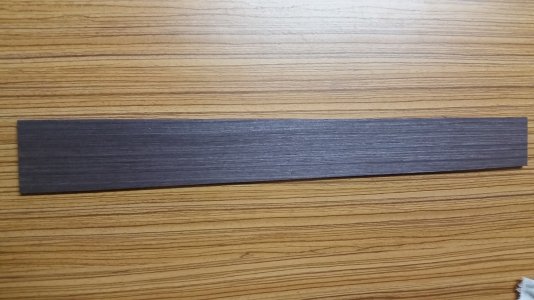
Introducing... Blackwood.

In China, they are calling this "copy rosewood" (and "copy ebony" for the darker variety).

It is not synthetic... it is real wood, but it has been "treated" (don't ask me) in some manner as to give the appearance, structural integrity and feel of Rosewood... with a view that it may be used as a Rosewood substitute... if it every did get to that stage.

AND... we have just received some samples!
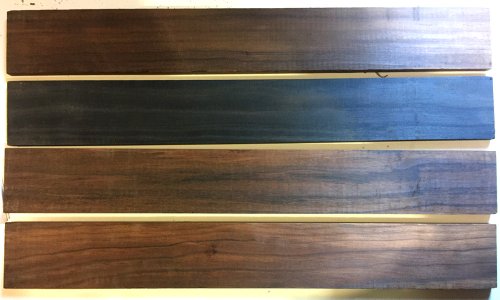
Blackwood.jpg

It does actually look pretty good... even better than the genuine Rosewood and Ebony fretboards we have had from our supplier.

I would like to distribute these 4 samples to you builders, so we can get some carefully considered feedback.

If you're interested in this issue and you're in a position where you could thoroughly test the Blackwood... even building a neck with the Blackwood as the fretboard, please let me know and we will send you a sample. International builders please apply (that means you Simon B.)

We really want to know how it handles in the build process and how it feels when actually playing.

I think this will be important research and I predict a lot of people (including manufacturers and suppliers) will be watching this and will be keen to hear what YOU think.

Let us know here if you're up for it and we will help to make it happen.
 
Well there ya go. I was also under the impression that Indian Rosewood was on the list, but as there is so much consternation in the Luthiers world around the new rounds of banned and to be banned timbers I guess some wires have been crossed.
Look forward to getting me sweaty hands on one of the samples.
 
From what I understand, all Rosewood (and tree varieties with the same genus) is on the CITES class II endangered list. India asked for a 6-month delay on the application for their rosewoods, so for Indian woods that doesn't kick in until the beginning of August. But it mainly means that for the moment, the rosewoods (and similar genus woods like Bubinga) will still be available, but will have to be properly documented at all points of import/export, including their use in finished products - like kit guitar necks. So any exported kits will need a certificate for the rosewood used in the neck. I don't know how much extra work or cost will entail you, Adam, but it might make the kits more expensive to export.

Obviously the move to put all the rosewood family on the class II list shows that supplies are dwindling globally and needs to be very well managed to ensure continuing availability.

I'm not that fussed about having a wood with similar properties to rosewood being used on necks, as long as it has a similar feel and long-term fret retaining properties. I do have an old Gibson acoustic with a fabled Brazilian Rosewood board, and to be honest, it's nothing special.

I'm not ready to make my own necks yet, but I'd be happy to have a small length of the Blackwood, enough to try fitting a fret to. That should give me enough to get an idea of feel and workability. Maybe if only 3 people want to build a complete neck with it, you could saw the other piece up for smaller samples?

Are the Chinese calling this treated wood 'Blackwood' themselves, or is it really an African or Burmese Blackwood (which are both in the rosewood family so covered by the CITES changes and rules) or an Australian Blackwood (which is an acacia so exempt) or a totally different wood that has been heat treated to darken it that they have given a name to that could cause confusion at import/export time? They might want to reconsider the name and call it something more unique!
 
My hand is up too Adam
Ive been talking to a few contacts in China and each one has told me something different! So interesting times, one supplier in China I know is now doing Walnut and Wenge and what they are calling fake Rosewood which may be similar to this.
Buyer beware if anyone is thinking of buying direct from China (and not through Pitbull), one company told me that all sea freight they send would have certificates issued but their air freight they would just send as normal ie no paperwork.... wonder how many guitars and necks wont get in the country!
 
From what I understand, all Rosewood (and tree varieties with the same genus) is on the CITES class II endangered list. India asked for a 6-month delay on the application for their rosewoods, so for Indian woods that doesn't kick in until the beginning of August. But it mainly means that for the moment, the rosewoods (and similar genus woods like Bubinga) will still be available, but will have to be properly documented at all points of import/export, including their use in finished products - like kit guitar necks. So any exported kits will need a certificate for the rosewood used in the neck. I don't know how much extra work or cost will entail you, Adam, but it might make the kits more expensive to export.

Obviously the move to put all the rosewood family on the class II list shows that supplies are dwindling globally and needs to be very well managed to ensure continuing availability.

I'm not that fussed about having a wood with similar properties to rosewood being used on necks, as long as it has a similar feel and long-term fret retaining properties. I do have an old Gibson acoustic with a fabled Brazilian Rosewood board, and to be honest, it's nothing special.

I'm not ready to make my own necks yet, but I'd be happy to have a small length of the Blackwood, enough to try fitting a fret to. That should give me enough to get an idea of feel and workability. Maybe if only 3 people want to build a complete neck with it, you could saw the other piece up for smaller samples?

Are the Chinese calling this treated wood 'Blackwood' themselves, or is it really an African or Burmese Blackwood (which are both in the rosewood family so covered by the CITES changes and rules) or an Australian Blackwood (which is an acacia so exempt) or a totally different wood that has been heat treated to darken it that they have given a name to that could cause confusion at import/export time? They might want to reconsider the name and call it something more unique!

Gooday Simon I was thinking that as well as African Blackwood is listed... I was sent a photo from a Chinese supplier I know of what they are calling Fake Rosewood (pic attached) and it may be similar to what Adam has.
 

Attachments

  • Artificial Rosewood.jpg
    Artificial Rosewood.jpg
    785.3 KB · Views: 664
Hey Euroa, yes, that will be it. The Chinese are all over this fake/copy Rosewood. I believe it's a Chinese company making it, from a product developed in Australia.

Check out http://www.blackwoodtek.com.

So, I've got 4 pieces and there's yourself (Euroa), Simon and DB... one to go.
 
A lot of manufactures are actively looking at alternatives, a lot of them resin/wood fibre composites, and most are using them or alternative woods on their lower priced offerings. Martin is very good at doing this. Gibson used baked and darkened maple boards on a lot of their guitars during their run-in with the US Govt. over whether their rosewood was legal or not. Didn't go down too well at the time with critics, but people with the guitars seemed to think they were OK (but there were reports of some longer term issues). Roasted maple necks seems to be very popular on Fender styles at the moment.

Most people don't really touch the fretboard that much when they play (unless they have really low frets), so as long as it's smooth, looks OK, holds the frets well, is going to last as long as rosewood, doesn't affect sustain or move the overall tone away from what they are used to hearing, then I'm really not too bothered about the material.
 
Hey Euroa, yes, that will be it. The Chinese are all over this fake/copy Rosewood. I believe it's a Chinese company making it, from a product developed in Australia.

Check out http://www.blackwoodtek.com.

So, I've got 4 pieces and there's yourself (Euroa), Simon and DB... one to go.

That looks really cool Adam, its funny it seems some Chinese suppliers are all over this and on the front foot whilst others are seemingly in the dark and don't want to know about it. It will be interesting to see how it all pans out by the end of the year. This Blackwoodtek looks like it may be a decent alternative to both Rosewood and Ebony. Doing a Les Paul Jnr with a Sapele body and a Maple neck and was going to do Rosewood fretboard so will use this instead and see how it turns out...Funny how it takes something this dramatic for people to start looking at more sustainable alternatives
 
So glad I have a fairly extensive collection of tasty Australian tonewood stashed away and a good source for more...
Won't be long before it becomes impossible to source exotic timbers.
 
Ok, thanks Guys, I'll get a full piece of Rosewood to DB and Carl. Tony, are you ok with the "Ebony"? I think it's the same wood, just coloured darker.

The other rosewood piece I'll cut in thirds and send a piece to Simon, Gavin B and Brendan. Simon, a small piece will save me some Intl postage, so thanks for the suggestion.

Sorted
 
Going by the website, it's going to be a softwood fibre pulp mixed with a natural resin plus some dye, so it should all be the same consistency, regardless of the colour. I'm very interested to have a look at it.
 
Adam

Ebony coloured is fine.

Doing a Blackwood neck for this, this weekend so will be able to use pretty much straight away.
 

Attachments

  • 11E3635C-F788-4DA1-BA63-4A9888A2AFD9.JPG
    11E3635C-F788-4DA1-BA63-4A9888A2AFD9.JPG
    345.2 KB · Views: 257
  • FF3FA4D8-A211-48EF-812A-D35E843F5E67.JPG
    FF3FA4D8-A211-48EF-812A-D35E843F5E67.JPG
    338.1 KB · Views: 244
This may seem like an naive question, but why do we have to go through this process now (ie: certificates etc) for Rosewood, but not for Ebony - which have several species listed as either vunerable or endangered? Maybe don't ask Dept. Of Ag. or we'll start certificates on Ebony too ;)
 
This may seem like an naive question, but why do we have to go through this process now (ie: certificates etc) for Rosewood, but not for Ebony - which have several species listed as either vunerable or endangered? Maybe don't ask Dept. Of Ag. or we'll start certificates on Ebony too ;)

It is actually CITES that determines which timbers are endangered, it is then up to individual Governments to enforce any restrictions or bans. ( thats my understanding anyways, quite happy to be corrected on this)
Unfortunately most African countries are not interested in preserving tree species that have a commercial value, hence Ebony is not protected yet.
 
From reading on the CITES webpage, CITES protection seems to be a two-way thing. A country can ask for certain of its wood species to be put on the CITES list to help stop illegal logging in that country, whilst I'm sure CITES keeps an eye on the global situation and suggests to countries that it would be a good idea if they put a species on the list (otherwise I'm sure the recent global Rosewood listing would not have taken place on a unilateral basis). A country can opt out or defer implementation of a listing (as India deferred its Rosewood listing for 6 months) but most generally see it as a good thing.

Some Ebony is on the CITES list: CITES ebony list. As always, there are many varieties of ebony (genus Diospyros) and there is one variety Diospyros Ferra that is on CITES list II just about everywhere it's grown (including a lot of Africa). Otherwise, all Madagascan ebony is CITES II listed and Sri Lankan ebony is simply a banned wood and can't be cut down, so isn't available. These countries were the two major ebony suppliers.

Also, a lot of the Madagascan ebony CITES listings came into effect in mid-2013, so most suppliers will still have a lot of old logs drying out. But once that supply is gone, then most ebony will need certification.

But a lot of the non-listed ebony isn't the dense black wood you normally think of, but a very pretty, highly figured with obvious light to dark brown patterns, but still with a very closed grain and minimal pores, making it a lot smoother than rosewood for fretboards. However it's hard to work, and a lot of industries prefer a less figured look, so isn't that popular as a general wood. In fact, a lot of this type of wood had simply been thrown away in the past, as not all of the 'black ebony' trees had dark wood all the way through (normally just the central core), so any non-black wood was discarded.
 
The factory I've been talking to in China about Rosewood and CITES and what options they have for dark wood sent me the following message about Ebony and how they see its export.......

"Frankly speaking, ebony has been listed on CITES II many year ago. Recently, the exportation of ebony will be
influenced a little bit due to rosewood issue."
 
I've just received my sample in the post. It looks pretty good, even close up. I had an immediate use for a small slice of it as I am working on a mates steel resonator, and needed a thin piece of wood to replace a small wooden block that had fallen out that was actually what the end strap pin screwed into. A bit of sanding to give it a slight wedge shape and it fitted in perfectly between the body and the top wooden support beam. It's now being glued in place.

First observations are:

1. The dust is evil. Because it's soft wood in a resin material, the resin takes on a static charge and so the dust sticks to everything.
2. There's not as much 'give' in it as with normal wood. I drilled a normal sized hole (3mm) for the strap pin screw to go in, but I couldn't screw it in very far before it became too tough to do, so had to use a 3.5mm drill before it would screw in. So it looks like it should hold fret tangs in well (radiusing a piece and putting in a couple of frets is my next task, if I can find my spare fret wire).
3. Cutting through it with a normal tenon saw, the sides of the cuts on the top surface tended to 'chip' rather than make splinters. Not big chips, but I think you'd need a very sharp fret saw in order to make clean cuts that didn't have any visible chip indents that weren't covered by the fret.
4. I tried putting lemon oil on a piece (as unsuspecting people might well do). It went very dark and whilst not completely sitting on the surface, it didn't look like it was sinking in much either. As the moisture in the wood is pretty much sealed in by the resin, it shouldn't dry out, so oiling won't be needed. The oil will eventually evaporate so it's not the end of the world if it happens, but it's best not to do it.
5. It doesn't smell like wood when cut. It's not unpleasant, but it's not that attractive either.
 
I wonder what's in the binding resin, I know I'm generalising here but Aisia is generally not highly regarded in terms of health and welfare when it comes to manufacturing materials & content.

Sincerely hope I'm wrong but using BA when cutting or sanding may be a good idea
 
It's supposed to be a 'natural' resin, according to the manufacturer's web site. But 'natural' doesn't stop the dust from having possible harmful effects.

Certainly dust masks and protective eyewear should be used for any dust-producing woodworking process. No dust is good for your lungs, and just about all types of wood dust have some form of toxic effect on the human body.
 
Back
Top