Straight pieces of solder or metal pins?

I’ve seen a few of these ‘pro’ wiring harnesses around, and envy their neatness.
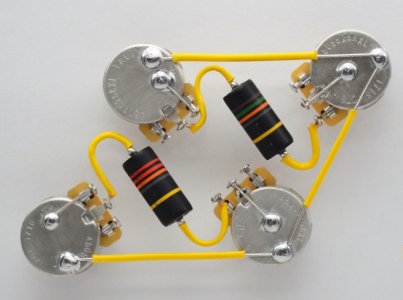
A83A21B7-CA3C-478B-8E01-45350174E284.jpeg

Are they running the solder in a straight line and using that? Or is it some kind of metal pin? Anyone tried this style?
 
I’ve seen a few of these ‘pro’ wiring harnesses around, and envy their neatness.

View attachment 35341

Are they running the solder in a straight line and using that? Or is it some kind of metal pin? Anyone tried this style?

Are you talking about the wire links from the pot body to the lugs? That is tinned copper wire and it's available in rolls from electronics supply stores. I have a roll of 0.71mm from Jaycar. It's hard to judge the thickness/gauge from the photo, but it might be closer to 1mm diameter. It's available in lots of gauges.

DC
 
It's not solder, it's bare tinned copper wire, with some sleeving or heat shrink fitted over the top.

I've tried it and it works, but it's very hard to get it that neat unless you've done it hundreds of times. And you need to make a very accurate template to build it on. You can of course bend the wire if your holes are slightly further together, but then you loose the neat look.

And it doesn't make the guitar sound any better. Only practice can do that. ;)
 
Also, the insulated wires might also be the same tinned copper wire, but with heatshrink tubing. It's a bit hard to tell in the photo. It could also be insulated solid core wire but the stuff I have seen (like the vintage cloth pushback wire) isn't tinned. The tinning is why it looks silver instead of copper coloured, it helps solder adherence.

DC
 
I use the same technique in some locations when wiring effect pedals. It can be the simplest way to do a short run of wire where you don't need any flexibility or movement, such as bridging terminals on a pot or switch.

I imagine that the neatness is part of the brand for pre-wired harnesses. The neater it is, and the more retro the resistors and tone caps look, the higher the price.

Oh definitely.


Ahh tinned coper wire. That makes sense. Thanks guys.

May try it in future, my soldering is very poor in appearance anyway...but they do seem to work.
 
Also, the insulated wires might also be the same tinned copper wire, but with heatshrink tubing. It's a bit hard to tell in the photo. It could also be insulated solid core wire but the stuff I have seen (like the vintage cloth pushback wire) isn't tinned. The tinning is why it looks silver instead of copper coloured, it helps solder adherence.

DC
Pretty sure I've used pre-tinned pushback before or maybe I'm getting confused with braided. I know at least one variant of either one of those I've had before came pre-tinned. But certainly not all of them do.

Six String Supplies do a good tutorial using tinned copper wire here;

https://youtu.be/ZWxz2Ytjk0k
 
Last edited:
The single-core pushback is often tinned, but the multi-strand pushback generally isn't, as tinning the multi-strands once assembled would make it stiff, not flexible, and pre-tinning the individual strands before winding them together to make a single wire is a lot of hassle, which equates to a much higher price.
 
Back
Top