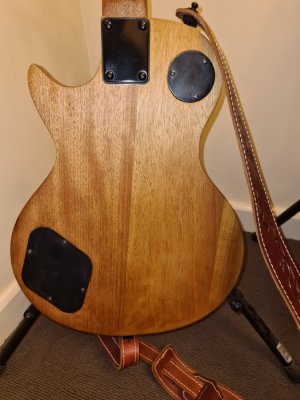
Removed Dingotone finish - like result - any advice on leaving without new finish.

DJP

Active member
*A Dingotone finish on an LP style build from about 4 and a half years back literally turned into treacle earlier this year. Sticky goo.
I destrung, took off the bridge and knobs and sat for hours with goof off, microfibre cloths and cotton buds removing the finish front and back.
The treacle came off successfully with a lot of elbow grease.
But here is my query.
I love the way the guitar looks. It is sparse - not relict - kinda very slightly distressed - and the spalted top is just lovely (I had originally grain filled it and its really very smooth). There clearly must still be some finish remaining in the wood because it is nowhere near like a new kit 😀. Just minimal finish with a little shine on it in the right light.

Will leaving it like this be problematic ? It looks so nice I want to keep it.
What would be best way of caring for such a minimal finished guitar.

Photos attached.
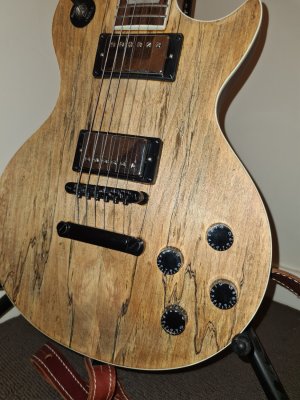
Resizer_16393300822170.jpg
Resizer_16393300822171.jpg
 
Last edited:
Will leaving it like this be problematic ? It looks so nice I want to keep it.
What would be best way of caring for such a minimal finished guitar.

The main reason for applying finish to a guitar is to seal the wood and minimise the expanding/contracting effects of atmospheric moisture (humidity).
I can't say with absolute certainty that leaving your guitar unfinished (or semi-finished) will end in disaster, but I'd be concerned about movement with the neck (relief and twisting) as well as build up of grime from body oil & sweat from your hands. As it's a screw-fixed neck, I don't see it affecting the neck join so much as possibly a set neck (??).

If it were mine, and I wanted to keep the current look, I'd apply a few coats of shellac* then some wipe-on satin poly (presuming you don't want a glossy finish).

*The only reason I'd do the shellac first is to prevent compatibility issues with the leftover DT and the new poly. Maybe poly over DT is fine, I don't know. I've never used it, and yours is just one more story confirming I never will. I don't know why people continue to use it.
 
I've used acrylic clear coat over a number of different finishes including DT and it's the clear coat that sticks to the guitar rack but none of them feel tacky to touch
 
How about a couple of coats of tru-oil? Enough to seal it, but not enough to make it glossy.

I put tru-oil over the DT stain coats with no issues on my FVB-4.

BTW - that spalted maple is fantastic. Great score.
 
Looks like you may have here the three best reasons to use shellac unless I am missing something (which I often am).

You need something to seal the wood. One of the principle uses of shellac is as a seal coat.

You need something that will stick to wood that may have a little degraded finish left in it. Shellac is famous for adhering to almost anything.

You want a cap on the wood so that the clear coat you use won't react with any finish left in the wood. Yet another major use of shellac.

Shellac is also cheap, fast, easy to use and non-toxic.

I resisted this logic for a long time before discovering that McCreed was right about the stuff ;-)


Sent from my LE2125 using Tapatalk
 
Thanks for the comments. I suspected this.
The neck is nitro finish. Its just the body.
Shellac sounds interesting.
Also - I do have a small unused bottle of Tru Oil - so perhaps this is a chance to use it.
 
Thanks for the comments. I suspected this.
The neck is nitro finish. Its just the body.
Shellac sounds interesting.
Also - I do have a small unused bottle of Tru Oil - so perhaps this is a chance to use it.

Tru Oil is certainly an option, especially if you already have it!
Just be aware that it does have a slight amber tint to it due to one of its components being boiled linseed oil, and it will slightly darken over time. I personally like the colour, but that's just me.

Also worth noting that shellac will also have a light amber hue to it, but a lot of how how much depends on 1) the type of shellac flake used - eg: blonde, light blonde, orange etc. 2) Number of coats - more coats = more colour.

Good to hear the neck is lacquer. That makes things easier.
 
I just went to Bunnings and said I was looking for a clear/light Shellac. The guy treated me like an idiot and incredulously told me all shellac is orange. Like the idiot he thought I was I believed him and bought it ! Doh ...
 
Last edited:
I seem to recall watching a vid on finishes and I could swear there was a lighter colour shellac. I wouldn't take everything they tell you at Bunnings as gospel... some of their staff are amazingly ignorant. I have been using a water based poly meant for marine applications.. it has a cross linker you add to it... it starts off looking like jizz but it dries very clear.
 
Bunnings is not necessarily the place to get buy shellac IMO. Also, you want to be sure you buy "dewaxed" shellac flakes, which IIRC, tha Feast Watson ones at Bunnings are dewaxed despite not saying so on the package.
The best places to source good (fresh) shellac flakes are proper woodworking supply stores. Many will have a choice of flakes or "buttons" and a range of colours.
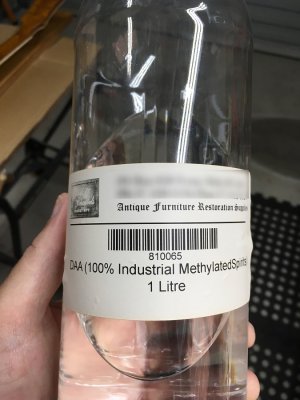
When it comes to dissolving the flakes, you want to source methylated spirits that are "industrial" (100% Ethanol) not the 95% Diggers you'll get at the supermarket (or Bunnings).

I'll post more on this later, I need to go out for a while...
 
When it comes to dissolving the flakes, you want to source methylated spirits that are "industrial" (100% Ethanol) not the 95% Diggers you'll get at the supermarket (or Bunnings).

<rases hand> erm, NO! 100% ethanol is *not* mentholated in any way shape or form, and what you are probably thinking of is nenatured alcohol. Via diatillation 96% is the best you can manage.. 100% is harder to do and costs a lot of money and requires certain licesnces to obtain. Since you are using it for a coating rather than to drink, and you want to go the no water route you would go for dessicated denatured alcohol . from memory it's 95% ethanl and 5% methanol. We used to buy 20L drums for the lab.
 
Sorry, I meant Methanol (aka methyl alcohol) not ethanol. What a difference 1 letter makes!

Metho 100 anon.jpg

It's about $10 a litre, but it makes a noticeable difference in dissolving the flakes.
 
Methanol, got 200L of that in the shed for my son's drag car.

Not sure of the chemistry of it though because it has an additive to stop it absorbing water and smell different at the exhaust but still makes your eyes water and hurt.

As you were, back on topic
 
This is all brilliant information. Thank you.
I did a bit of research and bought some dewaxed "platina" (also called ultra-blonde) Shellac flakes. Which sound like they will give the pale pale finish I want.

In the meantime ... was wondering how my Dingotone finished Tele has held up as I have not played it for ages and its been sitting in its case. It is an earlier build than the LP and the finish still seems OK - like new. Not at all tacky and certainly not treacle. ... and its a crime leaving it in the case so its been liberated 🙂
 
Last edited:
I think platina/ultra blonde is the least colored of all the shellacs. I have so far only used the blonde (from flakes) which adds just a little amber tint.

FWIW I use denatured alcohol to dissolve the flakes. I know some people non-denatured ethanol to make their shellac, but it's illegal in the state of Florida, and it's taxed as consumable alcohol everywhere it is legal in the US. It's theoretically possible to get lab-grade ethanol here, but I have no idea how.

I didn't know people used pure methanol for shellac. I have tried to avoid the stuff, and resented that the US Government forces mfgs to add 5-10% of the stuff to ethanol to *make* it toxic. This is one of the residual bad ideas that got its start in prohibition. Probably the time it killed the most people. It's a cat 3 toxic substance (which is mild), unless you ingest it. If you do that, it jumps to cat 1 because of the severe organ and neural damage it can cause.

Is there an advantage to methanol over DNA?
 
Methylated Spirits in Australia IS what you in the US call Denatured Alcohol.

I am not a chemist, and it seems I have managed to confuse myself (not hard to do these days) but I was correct the first time when I said Ethanol.

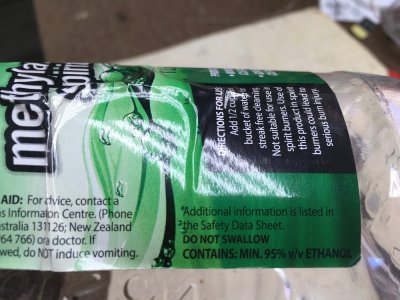
This is Methylated Spirits which we use here, and the run-of-the mill 95% stuff you get at supermarkets and hardware stores:

Metho 95.jpg

It clearly states 95% v/v Ethanol
 
Methylated Spirits in Australia IS what you in the US call Denatured Alcohol.

I am not a chemist, and it seems I have managed to confuse myself (not hard to do these days) but I was correct the first time when I said Ethanol.

This is Methylated Spirits which we use here, and the run-of-the mill 95% stuff you get at supermarkets and hardware stores:

View attachment 42146

It clearly states 95% v/v Ethanol

Well, I *am* chemist, and in a laboratory metho in Australia is called denatured alcohol.The stuff you get from Bunnings will be 95% ethanol, some methanol, some water and some other trace amounts of crap to make it even more undrinkable than the methanol makes it... although I suspect for the purposes of using it to solubilise shellac it probably doesn't makes much difference. Unless you get desiccated denatured or absolute ethanol (that's 100% and *very* expensive) there will always be some water in the mix. lab or industrial grade (like the pic> will not have the extra impurities they add to metho, just etrhanol and methanol. by 100% methylated spirits that does *not* mean 100% ethanol, or it would not *be* methylated spirits :P. But yeh... the industrial stuff is probably better than the domestic stuff :cool: .
 
Well, I *am* chemist, and in a laboratory metho in Australia is called denatured alcohol.The stuff you get from Bunnings will be 95% ethanol, some methanol, some water and some other trace amounts of crap to make it even more undrinkable than the methanol makes it... although I suspect for the purposes of using it to solubilise shellac it probably doesn't makes much difference. Unless you get desiccated denatured or absolute ethanol (that's 100% and *very* expensive) there will always be some water in the mix. lab or industrial grade (like the pic> will not have the extra impurities they add to metho, just etrhanol and methanol. by 100% methylated spirits that does *not* mean 100% ethanol, or it would not *be* methylated spirits :P. But yeh... the industrial stuff is probably better than the domestic stuff :cool: .

From what is obviously my tenuous understanding of this, it is the percentage of water content that makes the difference.
This is why shellac flake that has been improperly stored and subjected to moisture, will have difficulty fully dissolving.
 
Back
Top