PB-30R DIY Electric Bass Guitar Kit 30: Bridge Position

Tino

New member
Hello:
I am new here. I have purchased a PB-30R DIY Electric Bass Guitar Kit 30 and I am working on setting it up. The problem is that I don't really know where to place the bridge since it doesn't have any markings. Where can I find a guide so I don't make a mistake? Sorry for my English, I am using a Spanish to English translator.
 
Hi Tino,
the Pit Bull Manual can be found at https://www.pitbullguitars.com/instruction-manual/.

But I'm not sure if it answers your question.

I would:

First: With the neck in place, you need to use the "E-strings Method" (for 6 strings, so it should be called the E & G strings method for bass guitars) to align the bridge sideways. That is, run string from the outer nut slots on the neck, to the outer bridge saddle slots - making sure they are parallel down the neck. I then use masking tape to mark these positions on the body.

Second: Determine the scale length (which should be close to 30 inches for the PB-30R!). 1. Adjust the high g-string saddle on the bridge to nearly all the way out. 2. Measure the distance from the back of the nut to the 12th fret. If you double this value it should be very close to the scale length. 3. Position the bridge so that the g- string saddle is at your measured scale length. I use masking tape again to mark this position.

You should then be good to screw down the bridge.

The pictures below show the ideas for a 6 string.
 

Attachments

  • E strings method 2.jpg
    E strings method 2.jpg
    88.8 KB · Views: 62
Last edited:
+1, I do it exactly as TD suggests. Whatever the measurement is from where the string leaves the nut to the middle of the 12th fret, double it... if you don't have a long straight edge, you can take the 1st measurement and and just measure from the middle of the 12th fret to where the string leaves the G string saddle.

One thing to remember is that you a little margin for error with the saddles since you can move the saddles forward and back several mm's. You want to be as precise as possible with the lateral measurements. I do it by eye-balling, but I spend quite a bit of time getting it in the right place.

One thing that sometimes helps with basses, is that if you string the A and the D strings, they should bracket the position dots on the neck pretty perfectly when you have the bridge properly centered. For some reasons this occasionally works better for me than aligning to the sides of the fingerboard with the E and G strings.
 
PBass is 34" scale length is it not, but what F3x has suggested will be the correct method on any guitar regardless of scale length

My Yamaha short scale bass is 30" and somewhat shorter than my PBass
 
FWIW, it's good to check the length to the 12th fret. It should be 15 inches on a "perfect" 30 inch scale bass neck... My old short scale bass was actually 30.5 inches, and I think that at least some short scale Fenders were also a little longer than 30 inch scale. So the safest way to check the scale length is to measure from where the string leaves the nut to the middle of the 12th fret and then double that. That will give you the most accurate scale length. Don't worry if it's off by a mm or two. You should be able to compensate for that by adjusting the saddles on the bridge.
 
Hello:
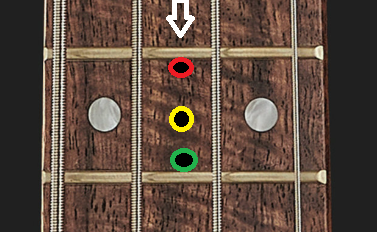
I have a question: to see the distance from the nut, where on the 12th fret is it measured, at the top, in the middle, or at the end of the fret?traste12.png
 
Hello:
I have a question: to see the distance from the nut, where on the 12th fret is it measured, at the top, in the middle, or at the end of the fret?

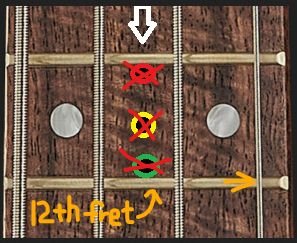
Just to be clear, the "fret" is the metal bar. So on a right-handed bass, your white arrow is pointed at the 11th fret. You don't measure from any of the dots you have added.

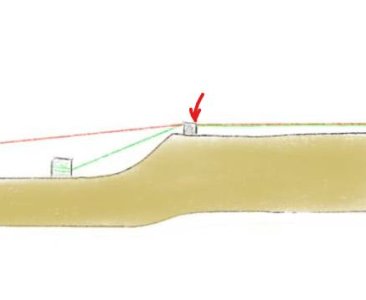
You measure from where the string comes off the nut...
nut_measure.jpg

...to the middle of the 12th fret.

12th fret.jpg

I measure along the course of the G string, which would be where I put the orange arrow.

Doubling that measure will give you the exact scale length. I measure the along the G string because it's the one that will be 30 inches on a 30 inch scale. All the other strings will be a little longer which you compensate for by adjusting the bridge saddles.

Nuts and saddles get measured where the string comes off. The fret gets measured in the middle of the metal bar.

You do the measurement from the nut to the 12th fret to test how long the scale length is. For example, if it is exactly 15 inches you have a 30 inch scale. If it is exactly 15.25 inches, then you have a 30.5 inch scale*. You can then measure (a) from the nut to the saddle, or (b) from the 12th fret to the saddle, whichever is easiest. I usually measure from the nut because I find it easier to rest my straight edge against the nut to do the measurement, but either way works.


*this is common on Gibson short scale basses.
 
Last edited:
Hi guys: Both your comment and Trevos Davies' have helped me a lot. The only doubt I have left is that you both recommend that to take the measurement from the 12th fret to the saddle, it should be almost at the end. Wouldn't it be more logical for it to be in the middle to have room for adjustment? Sorry for my ignorance.
 
Hi guys: Both your comment and Trevos Davies' have helped me a lot. The only doubt I have left is that you both recommend that to take the measurement from the 12th fret to the saddle, it should be almost at the end. Wouldn't it be more logical for it to be in the middle to have room for adjustment? Sorry for my ignorance.

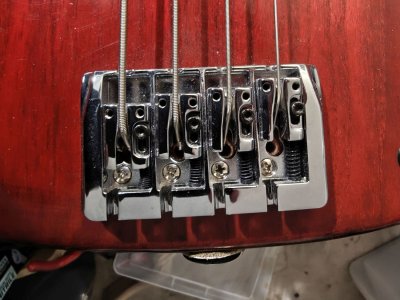
To correctly intonate the strings it works out that the thicker the string, the longer it needs to be. This can be seen in the image below. The E string is the longest, while the G string is the shortest. On the guitar shown there is about 6 mm difference in length between the G and E strings.

If you put the G string in the middle of the adjustment screw, then the thicker (D, A, E) strings will need to be further back. Then you run the risk of not having enough room for the E string. So, it is best to have the D and A string saddles about the middle of the adjustment screw.

The annoying part is that the scale length is roughly the length of the thinnest string. Therefore, position the G string saddle to be further forward.

I'm sure the saddle used in your kit is the same as in my picture - it has a lot of room for adjustment.
 

Attachments

  • IMG_1927.jpg
    IMG_1927.jpg
    203.7 KB · Views: 88
Last edited:
Like TD said, almost all of the adjustment will be away from the nut on the E A and D strings (in that order). On my favorite 34" scale bass, the distance between the nut and the center of the 12th fret was 431mm. That means the "true" scale length should be 862mm. After intonating all the strings, the G string intonated at pretty close to exactly 862mm. I didn't have to move the G string saddle at all to intonate--and that is typical. Even so, I had it set back about 3mm from maximum extension toward the nut--which is more adjustment toward the nut than I needed. The E string intonated at 7.63mm farther from the nut than the G string. You can see the difference in the picture.

sung-il.jpg

In retrospect I probably should have set the bridge back another 1 or 1.5 mm farther away from the nut. As you can see the spring on the E string saddle is very compressed and would not have given me much more movement back if I had needed it. The great thing about these adjustable bridges is that there is enough adjustability in them so that you can be off by a couple of mm without too much problem. :cool:
 
Back
Top