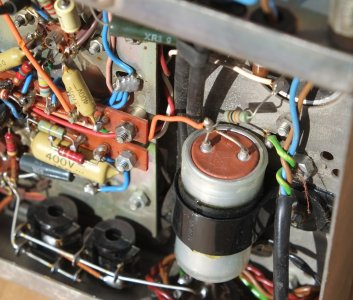
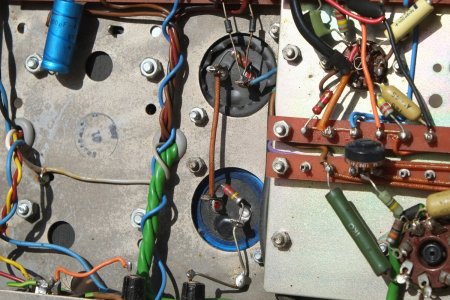
Firing up an old valve amp of unknown provenance

Simon Barden

Well-known member
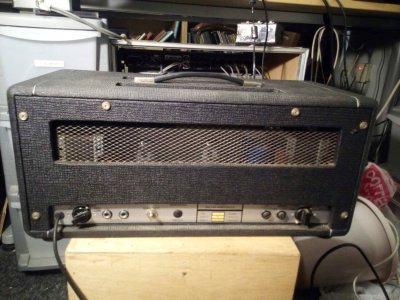
A friend of mine has unearthed a Sound City 50 Plus valve amp that has been in his loft for at least 10 years. It's a non-master volume amp with normal and bright channels. I'm interested in it, but he's scared of powering it up as he can never remember it being used. It was his partner's son's amp (he moved out 10 years ago), and he knows that the son never had a cab for it, so he may never have used it.

He's had a look inside and there are no signs of leaky or damaged caps. He's vacuumed it out but there wasn't a lot of dust in there.

I've told him to take the valves out first, check the fuses are OK, then fire it up with no valves in and make sure no fuses pop or smoke appears. Then stick the pre-amp valves in and run it again. If still OK, put the power valves in. (All done with the volume off and a cab connected).

I know some people recommend using a variac to increase the voltage slowly, but there is none handy.

Is my start-up suggestion OK? Anything else to consider.
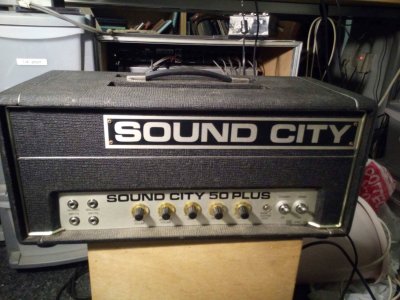
28643304_403643786761117_1279811088_o.jpg

28584443_403643890094440_1231181586_o.jpg
 
What you've suggested Simon is pretty much what I would do if I didn't have access to a variac.

An alternative is to wire a mains voltage 100W incandescent bulb in series with the amplifiers mains, which if there is any short in the amp will cause the lamp to light up brightly, and will only glow dimly and reduce the voltage slightly to the amp if the amp is okay. The best way of doing this is to make a jig with a lamp holder and a suitable power outlet both securely and safely mounted to a small wooden board. Some may choose to include a switch to bypass the lamp to allow full voltage checks without having to re-plug things.

Something to consider... Short of going over the entire amp with all the appropriate meters my usual practice when powering up old devices like this is to leave the amp on for a few minutes during the test... Caps are often a little slow to react to being put back to work.... Applying full voltage for 5 to 15 minutes once all the tubes are back in while maintaining a comfortable distance will inspire confidence that all is okay. Often it may take 5 or 10 minutes for a bad cap to build enough internal pressure inside before horribly and loudly detonating in one of those few moments while you are otherwise distracted..
 
Thanks Marcel.

100W incandescent bulbs are rare as hen's teeth now in the UK. They were banned several years ago, so everything (apart from speciality bulbs) are now low-energy bulbs, which are small fluorescent or LED types.

But yes, I understand the purpose/use. We often used to spec 'fuse failed' neon indicators on safety-related control circuits for HVAC control panels and MCCs.
 
Yeah, the impacts of some political and executive decisions are hidden, and sometimes only add inconvenience and cost to a once very cheap processes.

I have seen one 'jig' that used 110W worth of halogen down lamps (2 x 55W) with two step down transformers in parallel, and another jig that used a whole bunch of 15W incandescent oven lamps. What is needed is a purely (or mostly) resistive mains rated passive load capable of at least 2 or 3 times the wattage of the device under test and which does not care if it gets less than mains voltage applied to it. Nil SCR or dimmer control at all, but some minor inductance or small capacitance can be permitted. Due to the way they work I seriously doubt if twenty 5W LED style fittings in parallel would be entirely suitable for our field of audio purposes.
 
I think not. Luckily one can still get bigger wattage incandescent bulbs of the more specialised type. I think we've probably got some screw fitting standard incandescent bulb lurking somewhere that were accidentally bought instead of bayonet fitting ones.
 
What about heat lamps for medical purposes or the bathroom or for that matter what about bar heaters or space heaters if they still exist
 
You could also make sure you have some kind of a dummy load handy that you can plug into the speaker outs on the back of the amp, you don't want to end up frying the output transformer which could be expensive to replace, make sure the dummy load is the correct impedance and is rated for about the same power that the amp can put out.

First thing I would do is give the underside of the chassis a good look over just so that there's nothing obviously wrong, next thing I would do is use a multimeter to check that there are no shorts to ground from any of the mains power wiring going to the power transformer primary, also check to see that there are no shorts to ground on the secondary side of the power transformer too, depending on how old the amp is I'd be wary of the electrolytic caps if they look original, I think the useful lifespan of some electrolytic caps made back in the 60's or so used to be something like 20 odd years for some brands, nowadays the electrolytic caps we have available tend to be more reliable.

Having had first-hand experience of an electrolytic cap exploding, I can say that it's not a pleasant thing, they also tend to give off a quite pungent smell when they do go bang.

Those Sound City amps are supposed to be pretty good and worth quite a bit if they're in working condition.
 
Not worth anything like as much as a Marshall of similar vintage. This was an early 70's model. Obviously they'll be more common in the UK than elsewhere, but a very good condition version of that amp would go for around £350 max (around Aus$560). But even not working and sold for parts, they sell for around £220 (around Aus$350), so there's only a small margin for economic repair.
 
The main problem is that my mate lives about an hours drive away (without snow getting in the way) and he's not keen to fire it up. I've made an offer to take it as-is, so I'll see what he says. I don't need it, but another amp is always nice, especially as I don't have an EL34 amp at all, either 6V6 or 6L6. I'd then need to make a suitable cab, probably 2x12", which would then be another project for me when the weather turns warmer. It would look a bit silly sitting on top of my 1x12" Marshall cab.
 
If it still works properly, then I reckon it's worth hanging onto, all you'd need is a speaker cab with the correct impedance and enough power handling, hope it all works out.


I'm definitely hanging onto my Fender Super Twin amp, I've got a great amp with EL34 tubes in it, and now I've also got a potentially great amp with 6L6 tubes in it.

I'm just wondering if those Sound City amps are based on the Marshall JTM45, which was based on the Fender Tweed Bassman, from looking at the front panel layout, it looks similar to a JTM45.
 
Last edited:
Depending on the amps age it may be a good idea to check the internal wiring.

Bend the wires, especially close to the valve bases and make sure the insulation doesn't crack.

Caps can be a pain, especially electrolytics. Larger caps usually require reforming regularly during storage but probably not applicable in this case.

Alternatively, take valves out, fit RCD breaker, turn on and cross fingers--3 outcomes : bang, burn or nothing :)
 
Well, I finally took possession of the amp today. Checked lots of things first before applying power - mains and HT fuses were OK. Caps all looked fine. Took the valves out three nice Mullard ECC83 pre-amp valves (from 1974), I think the EL34s are Mullard as well by the date and type codes Xf3 and B5A4, so Jan 1975 (but any Mullard printing has either rubbed off them or never got put on top start with). Only the ECC81 PI seems to be another make.

But all is not well. Powered up neon came on, no bangs or anything. Waited a while and nothing happened. So started putting some pre-amp valves in. No glow at all. Put all the valves in. Not a single one glowed.

So I looked at the wiring diagram, measured the resistance across the '240v' primary winding on the mains transformer and it was open circuit to neutral. The '120v' tapping was a short to neutral. So it looks like the mains transformer is dead. Maybe someone tried it on the wrong tap setting.

This may already have been been a replacement transformer, as there were only two primary tappings, not 4 as shown on the schematics. However it could always have been a bodge job using an available transformer.

The 105v & 1150v positions were joined together on the voltage selector and the 245+225v positions were also linked (though the 220v position only had the wire passing through the eye and it wasn't actually soldered!).

Schematics here: (50 Plus Mk 4 head) http://soundcitysite.com/schems.shtml

So I'll need to find a new transformer if I can. There's a local amp tech, so I'll see what he says. But given that the primary side has gone wrong, does this indicate a problem on the secondary side?
 
From what you have said Simon I get the initial impression that whoever replaced the transformer did a back yard job of it. Very bad practice to go through one tap to get to another.
As the transformer is a replacement it begs the question did they put a large enough replacement in? If for example the transformer was only rated at 140mA on the HT coil and at some time latter the load averaged 160mA then there is a reason for it to overheat and blow the primary circuit thermal fuse that is often fitted to newer transformers primary windings. Same applies if the heater windings need to supply more than the rated current, the transformer heats up and the 'you only have one chance' thermal fuse blows. Transformer thermal fuses are typically wired in series with the primary winding neutral connection point and are usually set to blow at either 75C or 80C.

A bit of digging into the back story to the amp may help to reveal if this is the case. Are EL34's original fitment? What possible reasons are there for the the first transformer swap? Does the current transformer look big enough to do the job (when you compare its size against other amps of similar wattage).?..

If nothing in the rest of the amp looks stressed or appears to have suffered unexpected heat damage then it would be worth looking into fitting a suitably rated replacement mains transformer.
 
It looks about the same size as other transformers I've seen in photos, and it looks like it's using the original mounting holes. I'll take some pictures tomorrow.

It's certainly an EL34 amp design. I'm just guessing that the transformer may have been swapped due to the number of primary tappings, but it may have been factory fitted (badly) that way. But it did have a 'U.S.A.' paper label on the side of the transformer, so it may have come from a different amp (maybe a Fender), as there were and are still enough UK transformer manufacturers for Sound City to not to have to import any. It may even have gone abroad in its life, someone forgot to change the input voltage setting and the original transformer blew. I'll see if I can find anything about the part number on the transformer.

There may be someone on the Sound on Sound forum (my 'other' forum) who might know something (if he's still around) as they used to work for Roost, another small amp manufacturer who weren't too far from the Sound City factory and they got a lot of components from them.
 
If you are unable to source a replacement power transformer for the amp locally, you could try ordering one online from Evatco, since they stock both power and output transformers, here's a link to the Evatco website:


www.evatco.com.au


I'm guessing that the original power transformer was replaced (if that's actually what happened) because the amp probably developed a fault that pulled too much current from the power transformer, or the primary might have developed an internal short to ground, in which case the mains fuse should have blown first, we will probably never know for sure what actually happened, what I would do is go through every part of the amp's circuitry and check that everything is okay first before fitting a new power transformer, I would have to agree with what Marcel said in his posts.


Hope you manage to sort it all out and get it up and running again.
 
Last edited:
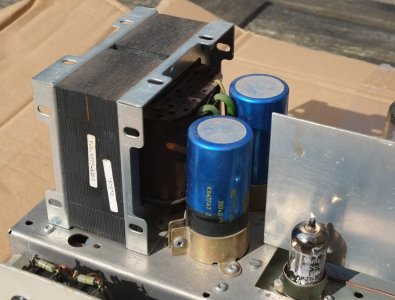
Well, a quick search for the transformer part number seems to indicate that it is a proper Sound City transformer, probably by Partridge - though this only comes from one hit on an eBay seller in Spain. The part number is T.G. 9875-A265.

Amp transformer 1 small.jpg

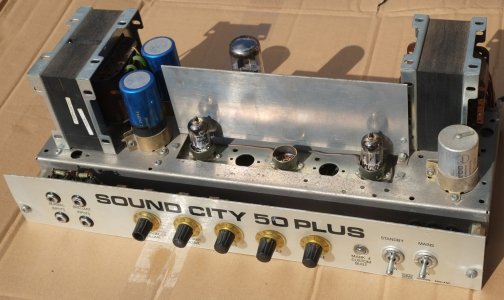
Here's the front of the amp chassis (some valves removed at the time):

whole amp chassis 1 small.jpg

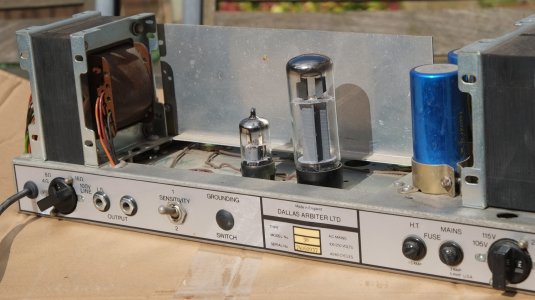
And the back. The PI valve sits between the two EL34s. This is a later arrangement as the PI was originally the other side of the metal shielding plate with the other pre-amp valves:

back of chassis small.jpg

Here's the only really suspect cap I could see with obvious cracking (though no leakage):

suspect cap small.jpg

Here's the bottom of the two main smoothing caps. They both seem to have a small bubble in the rubber/plastic covering, so I'm not sure if that's normal or not.

smoothing cap underside.jpg

Haven't had time to do any more real investigation as I need to tidy away all the stuff from the 'indoors workshop' (i.e. the dining room table), as we have friends coming over for a meal tomorrow.
 
Nice photos Simon.
By the looks of it I doubt the transformer has ever been replaced. And the caps look good enough to give them a chance. The dimples on the caps appear normal and are often found on these type of caps, and they are often included as a designed weak point to allow any internal over pressure to escape.

Based on these photos my educated guess from the other side of the world is that the thermal fuse in the transformer has let go. Be it an actual over temperature event or simply age related fatigue there is nil way of telling and your only option is to replace it, which looks to be a simple enough job to do...

As a side note. personally I have never liked that style of voltage and speaker impedance selector switches. For those who are not familiar with them (and that includes most guitarists) it is often all too easy to select the wrong setting. There is the not too remote chance that incorrect voltage selection caused the primary to blow without taking out the mains fuse. One way of checking is to see if the heaters/filaments of all the tubes are actually okay by removing all tubes and testing their continuity with a multimeter or test if they light up in another amp. Provided that since the transformer failure event none of the tubes have been changed then If any are open circuit (more than a few hundred ohms) then wrong voltage selection (110V selected on 220V supplied mains) is a very likely original culprit.
 
Well, a quick search for the transformer part number seems to indicate that it is a proper Sound City transformer, probably by Partridge - though this only comes from one hit on an eBay seller in Spain. The part number is T.G. 9875-A265.

View attachment 25478

Here's the front of the amp chassis (some valves removed at the time):

View attachment 25479

And the back. The PI valve sits between the two EL34s. This is a later arrangement as the PI was originally the other side of the metal shielding plate with the other pre-amp valves:

View attachment 25480

Here's the only really suspect cap I could see with obvious cracking (though no leakage):

View attachment 25481

Here's the bottom of the two main smoothing caps. They both seem to have a small bubble in the rubber/plastic covering, so I'm not sure if that's normal or not.

View attachment 25482

Haven't had time to do any more real investigation as I need to tidy away all the stuff from the 'indoors workshop' (i.e. the dining room table), as we have friends coming over for a meal tomorrow.


Heard lots of good things about Partridge transformers, apparently they were used a lot in Hiwatt amps.
 
Yes, Marcel, the voltage and impedance selectors aren't great. I'll need to keep the impedance selector but I plan to hardwire the voltage selector for the 245v setting (and add a label on the back to say so).
 
Looks like an old school Marshall copy.

My first amp was a Marshall JMP Super Bass 100, probably built in 60's or early 70's and it had the same voltage and speaker impedance plugs too. Dead set easy to knock them out without noticing.
 
Back
Top