Artist Oil Paints For Staining. Question Re: turps

Rodc

Member
Hi guys,

I have been using artist oil paints for staining my guitars. I have not used them on a a veneer top though.
I use 2 parts turps and one boiled linseed oil. I'm just concerned using the turps on a veneer could lift the veneer by weakening the glue.

Thinking of using metho. I remember someone saying use a light wipe of metho to show glue spots because it evaporates quickly but I don't think it would mix well with oil paints.

Thoughts?

Thanks, Rod.
 
AFAIK, metho will not mix well with oil based paint.

As for turps & the artist's oil paint on the veneer, I'm going to go out on limb and say it would be no different than using an oil based stain like Feast Watson, and plenty of people have done that without issue.

Not sure why you need the BLO in the mix. I know artists do that when painting on canvas, but I thought that was about texture/consistency as well as acting as a drying retarder. I don't know where that came from as I have never done an oil painting in my life.

Light applications of a spirit or oil based stain/dye (or even water based for that matter) won't be a problem on veneer unless you absolutely saturated it. Then maybe it could have an effect on the adhesive.
 
Thanks again Mc Creed..👍
I use the linseed oil for the drying agents. It does give a yellow cast as you know because of its colour.
Now it’s hotter weather I might mix up just turps and artist paint and see how long it takes to dry.
 
As for turps & the artist's oil paint on the veneer, I'm going to go out on limb and say it would be no different than using an oil based stain like Feast Watson, and plenty of people have done that without issue.
.

Remember FW prooftint stain is spirit based.
 
Remember FW prooftint stain is spirit based.

You are correct BD!
I looked at MSDS earlier only to discover it is indeed alcohol based! All this time I presumed it oil based because it be used to oil based poly/varnish.
I have also diluted it with mineral turps before with out issue.

Makes me question my opening advice now...

Always learning here thanks!
 
Be interested to see how using oil paints goes long term. I did a few works at art school with it, but generally used acrylic more often as it was faster and brighter.

Artist oil paint takes a very long time to fully cure, months and years, it's one of the aspects of the medium that people like as it allows really nice blending and adjustment during the period you are painting. You can see on old master works where the finished painting has been sealed, but overtime the underlying paint has continued to dry and shrink causing the top to 'craze' and crack. There is also the issue of colour stability over time, probably improved with modern pigments, but a lot of oil paint shifts colour over time, often darkening or losing pigment entirely.

Thinning it would speed up dry time I suppose. Somebody a while ago posted about doing this and I expressed caution for the above reasons, but I guess the best way to know for sure is to try it and see how it goes over time.

As already mentioned metho is not compatible with oil paint. We generally used white spirit or gamsol to thin it, but I'd suspect tehy would have a similar effect to turps on glue.
 
Last edited:
Be interested to see how using oil paints goes long term. I did a few works at art school with it, but generally used acrylic more often as it was faster and brighter.

Artist oil paint takes a very long time to fully cure, months and years, it's one of the aspects of the medium that people like as it allows really nice blending and adjustment during the period you are painting. You can see on old master works where the finished painting has been sealed, but overtime the underlying paint has continued to dry and shrink causing the top to 'craze' and crack. There is also the issue of colour stability over time, probably improved with modern pigments, but a lot of oil paint shifts colour over time, often darkening or losing pigment entirely.

Thinning it would speed up dry time I suppose. Somebody a while ago posted about doing this and I expressed caution for the above reasons, but I guess the best way to know for sure is to try it and see how it goes over time.

As already mentioned metho is not compatible with oil paint. We generally used white spirit or gamsol to thin it, but I'd suspect tehy would have a similar effect to turps on glue.

Thanks SM. I tried a mixture of 1-1 turps and boiled linseed oil on some titebond spread on some ply. I let the titebond dry for 24 hours first. I actually saturated the titebond with the mixture. Scrapped a screw driver over the saturated area and the other area where I left just the glue and couldn't really notice anymore softness in the glue.
I've already done one guitar with artist oil paints so time will tell.. ;)
 
Hi Rodc,
It would be interesting to see a photo of your results. I paint with artists oil paints. The medium or vehicle is raw linseed oil except for whites which are Safflower oil. As Sonic Mountain mentioned, they have a slower drying time than most paint. But some are quite quick depending on the pigment and how loaded with pigment the oil paint is. Boiling linseed oil speeds up the drying time. The pigments in oil paint will stain raw wood. On unprepared surfaces the oil will separate from some of the pigment.

Will do Mark, I'll get some photos today.
 
Hi Rodc,
It would be interesting to see a photo of your results. I paint with artists oil paints. The medium or vehicle is raw linseed oil except for whites which are Safflower oil. As Sonic Mountain mentioned, they have a slower drying time than most paint. But some are quite quick depending on the pigment and how loaded with pigment the oil paint is. Boiling linseed oil speeds up the drying time. The pigments in oil paint will stain raw wood. On unprepared surfaces the oil will separate from some of the pigment.

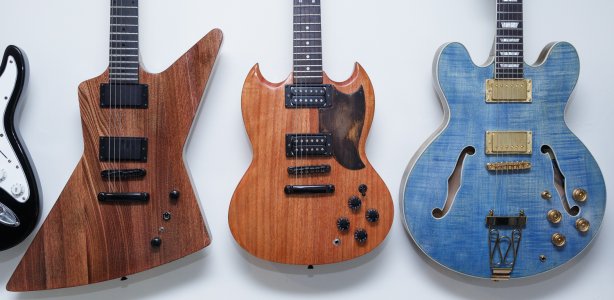
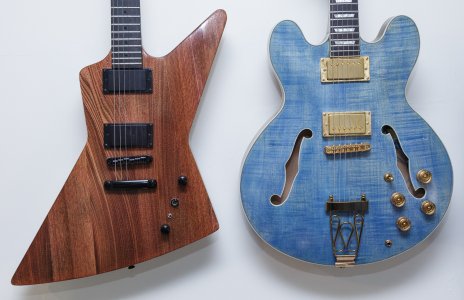
Hi Mark, the SG style guitar in the middle was my first and I used Dingotone.
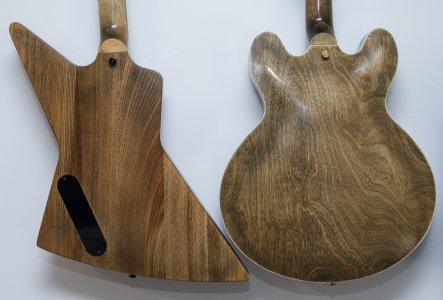
The ex guitar is Ash and I used a black grain filler for that. Mixed 3 different colours to get the brown reddish colour. The back is grain filled black with tru oil. The 335 style guitar my son wanted a faded denim look. We experimented on some 3 ply pine to get what he wanted. The top was pretty ordinary. Had a rub through from factory and a small ding in the same spot. About 6 decent glue spots I didn't find until I started staining. The back is I think burnt timber, which is a dark brown mixed with black. No grain fill.
 

Attachments

  • IMG_1965.JPG
    IMG_1965.JPG
    560 KB · Views: 175
  • IMG_1968.JPG
    IMG_1968.JPG
    740.7 KB · Views: 182
  • IMG_1969.JPG
    IMG_1969.JPG
    783.9 KB · Views: 160
Wow, rod! Those are some really nice colours.
Despite your problems with the ES, that colour works to really nice effect. It truly looks like faded denim to me!

I'd certainly consider artist oil paints as a viable finish option now. Good work.
 
Wow, rod! Those are some really nice colours.
Despite your problems with the ES, that colour works to really nice effect. It truly looks like faded denim to me!

I'd certainly consider artist oil paints as a viable finish option now. Good work.

Thanks McCreed. Bit of experimenting but you can't go wrong really finishing with Tru Oil. Because of the heat wave and humidity here after 12 coats of tru oil I put another 20 on 50/50 turps. The Tru oil warmed the blue up as well. That's what we were hoping for when we mixed the colour..
 
The Tru oil warmed the blue up as well. That's what we were hoping for when we mixed the colour..

I seem to have missed that it was finished with Tru Oil.
There have been numerous posts about Tru Oil over blues turning them green over time.
As far as I know, they have been deeper hues of blue though, so maybe your lighter shade will be ok.
Just thought I'd mention it.
 
Yes I read the same thing McCreed. I’m thinking with the lighter colour as you said it should be ok. With the trial pieces I try adding more linseed oil then adjusted the colour to suit. Touch wood, pardon the pun it should be stabilised..
 
Back
Top