


Btw the original guitar body was sold to EVH cheap as it had a flaw in it, an unsightly knot, so yours is perfect!


And I agree that there's no need for locking tuners with a locking nut. The only real benefit of them on a non-trem guitar is in the quickness of changing strings, and as quick changing of strings isn't going to happen on a Floyd-equipped guitar, a few extra seconds to wrap the string around the post won't make much difference.

While I'm applying the never ending layers of Tru-oil on my thinline ST build and having just completed my AG (well, mostly - but are they ever really completed?), I figured it's about time to start trying to source all the bits for this one.
So, I looked into the FR Special eBay link that Andy sent and noticed that even though it says R3 nut, the description says 10" radius but the R3 is supposed to be 12" radius. I figured I'd just ask the seller to confirm that it was a typo and it is indeed an R3 (12") nut since they have a separate eBay item with an R2 nut. I was expecting a reply that confirmed this assuming a copy/paste error but their reply had me less than confident about making the purchase. Something along the lines of there not being much difference between 10" and 12" radius.
Headed on over to Stewmac where they sell the FR Special kits and they're cheaper than the eBay auction, even with shipping factored in. However, the kits are only sold with R2 and if I want an R3, I'll need to buy that on top. Still, it's cheaper than buying all the bits separately. They also list the item as having a brass sustain block, but the picture looks like zinc alloy. They said they'll check and confirm that so I know if I need to order that or not.
So, a very long-winded way of getting around to my question. The sustain blocks are sold in 32mm, 37mm and 42mm. The 42mm is listed as being for flush mounted, 37mm for recessed and 32mm for deeply recessed. I'm assuming 42mm since I'll be flush mounting but to be sure, I'd like to measure something. Problem is, I don't know what measurement I should take. The 42mm seems like it should be the right one but I hate guessing.
It partly depends on the thickness of the body. With a thin body, a 42mm flush mount may be too deep, especially if you have a trem cavity cover fitted (which may well be recessed on some guitars, reducing the available depth).
The trem claw springs fit on top of the block and so add a couple of mm to the depth. Also, as the trem is operated, the block angles and so may poke down a bit more, as you have the diagonal block dimension to consider. It’s far less a problem (maybe none at all) on a downward trem only set up as the trem plate is only moving away from the body, but certainly needs to be considered for upward bends. But to be safe, you’ll probably need to set the trem about a minimum of 1mm from the body to allow the trem to pivot cleanly, so you gain that distance back.
So to prevent the block/spring ends from ever poking out of the trem cavity or snagging on the trem cover, you probably need a minimum body depth of 42+2+1 = 45mm. Greater if there’s a recessed trem spring cover.
With routing to allow upward bends, the trem plate still sits at the same position at rest on the body, but the more the rear of the trem plate moves downwards as you pull up, pushing the end of the block down as well. When doing pull-ups, a longer block will contact the front edge of the trem cavity sooner than a shorter block, which is the main reason for the shorter blocks. No point having a 10mm recess when the rear end of the trem stops 6mm from the base of the recess because the trem block has hit the front on the trem block rout.
A shorter trem block means the springs have less leverage on the trem and also are stretched less for a given movement of the trem arm, so for a 32mm block, you may need 4 springs to get the same feel as 3 springs on a 42mm block. You’ll certainly need to screw in the trem claw a lot more as a bare minimum.
Thanks Simon. This will be set to dive only. I've got a D-tuna somewhere (haven't seen it for a while so I hope I can still find it) that I was thinking of putting on this so if it's not already blocked from upward bends due to surface mounting with no additional routing, then I was going to install a block if I had to.
Will take some measurements while I'm waiting for Stewmac to respond.
Haha. If my playing and my ears were good enough to be able to notice any difference then I might think about it. To be honest, I could probably make one out of scrap timber and it wouldn't sound any worse. Certainly wouldn't be the weakest part of my sound anyway.Originally Posted by Simon Barden

After a long hiatus, I've decided now is the time to get started on this. I had some issues with a different build which gave me the shits and caused me to lose all interest in building for a year or so and it just sat there untouched for over a year. Anyway, I eventually got around to mostly finishing that build a few weeks back and will post that in my other thread when I get around to doing the filing of the nut slots, the neck adjustments and the intonation.
So, back to this one. This is the first time I've had a kit with a bolt on neck and the holes weren't drilled in the body. Not sure if this is how it's supposed to be supplied, but not a big deal. So, I carefully lined it all up and drilled out the holes and bolted on the neck. The first thing I noticed was the neck was not sitting evenly aligned with the body - in that the low E side sits a little higher than the high E side. I did notice that there was a slight gap between the neck and the body on that side which was caused by me not drilling big enough holes in the body so the screws were threading through the hole rather than sliding through. So, I resolved that and eliminated the gaps, but it still wasn't sitting straight. Took it all apart again and measured the pocket and some heel measurements. Pocket seemed nice and even depth throughout but I discovered the top of the fretboard to the bottom of the heel on the low E side is about 1mm more than the high E side. Knowing that, it's now quite obvious when I look at it.
So, I gather I'm going to need to sand this heel back to even it out. I don't have access to anything like a bench sander so I'm thinking at this point I'm looking at files and hard backed sandpaper. I'll measure it out and mark it all so I know where I need to be sanding to, stopping and checking frequently.
However, these are my thoughts and I tend to find the rest of you have better advice, so I'm going to leave this open to advice and not touch anything yet. I'm lacking the required equipment to do anything right now anyway. Last thing I want to do is make it worse.

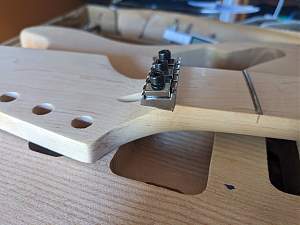
I have at least pulled off the kit nut, filed down the wood and installed the locking nut. Might need to go down a bit more but will leave it as is for now and worry about it later when I can measure it correctly.
 Posting Permissions

 Reply With Quote