


So I got bought an (Amazon) Strat kit for my birthday in May, all looked good til I pointed out to my son he'd ordered a Right handed kit and I am a lefty. That was duly sent back and said son left me to order one for myself.
Eventually, after a while trawling the inter-web I found Pitbull and was really impressed with the variety and a great range of lefty kits.
I decided on a TL-1L, something simple for my first build, hoping it will be a learning curve that may lead to other builds in the future.
It was finally ordered in July and arrrived here in the U.K. 2 days ago.
Out of the box it looks really good, the body is free from any major marks and everything just about fits, with the neck and body fitting well together. I haven't opted for any extras as I thought I would get it built first and then do some upgrades at a later date.
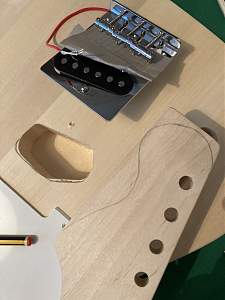
First job was to get and read the instruction guide and I have since been watching numerous how-to videos on Youtube. I have pencilled on a possible enlargement needed for the bridge pickup routing and a headstock shape but have not taken a tool to it just yet.
One question I am puzzling over, as a complete novice, is whether this is meant to be a 'toploader' or 'through the body' as the bridge seems to have 2 lots of 6 appropriately placed holes where the strings could be threaded just to the back of bridge or down through the body, I don't see any attachments to create a secure through-the-body hole, but I may be mistaken. I certainly don't want the strings to rip out the bridge when they are tightened. (I do own a Takamine Acoustic and an Epiphone Les Paul but they are obviously fitted with different style bridges).
I'd appreciate any pointers on this.
Thanks


 Reply With Quote


